


Safety & Battery Tech
Safety & Battery Tech
Travel Adapter for China: Plug Types, Voltage and the CCC Rule Nobody Mentions
The China travel adapter guide for Singapore travellers: Type A and I plugs, 220V, and why your power bank needs a CCC mark on domestic flights.

Yes, you need a China travel adapter from Singapore: mainland Chinese sockets take flat two-pin Type A and angled three-pin Type I plugs, not our Type G. Voltage is not the problem, since China runs on 220V, close enough to Singapore's 230V that any 100 to 240V charger works as normal. The part most guides skip is your power bank, because on domestic flights inside China it needs a visible CCC mark.
This guide walks through the sockets you will actually meet in hotels from Shanghai to Chengdu, the CCC (China Compulsory Certificate) rule and what it does and does not cover, and a short checklist to run before you leave. We have built travel charging gear in Singapore since 2010 for more than 500,000 customers, with a 24-month warranty on every product. If your trip includes even one internal flight within China, the power bank section is the one to read twice.
China travel adapter basics: which plugs fit the wall
The first hotel room in Shanghai usually explains it. A wall plate with five holes: two flat slots on top, and an angled three-slot pattern below. That is the standard Chinese combination socket, and your Singapore charger fits neither half.
WorldStandards' China page describes the official socket as a hybrid that accepts Type A (two flat pins, the American shape) and Type I (two angled flat pins plus an earth pin, close to the Australian shape). Grounded appliances use the three-pin Type I. You will also come across older or hotel "universal" sockets that accept round two-pin European Type C plugs, but you cannot count on them.
The voltage: no converter needed
China runs on 220V at 50Hz. Singapore runs on 230V at 50Hz. For practical purposes that is the same electricity, so anything you use at home, including most hair dryers, works in China once the plug fits. This is the opposite of Japan, where 100V catches people out. The only job your adapter has here is shape.
Hong Kong is different
One quick honest aside. If your trip starts in Hong Kong before crossing into Shenzhen, your Singapore plug will work in Hong Kong's Type G sockets and then stop working at the border. Plenty of travellers learn that in a Shenzhen hotel at midnight.
| Item | Singapore | Mainland China | What to bring |
|---|---|---|---|
| Plug type | Type G | Type A and Type I (some older sockets take Type C) | US or AU-style pins |
| Voltage | 230V, 50Hz | 220V, 50Hz | No converter for 100 to 240V or 220 to 240V devices |
| Power bank on domestic flights | Not applicable (no domestic flights) | Must carry a clear CCC (3C) mark, no recalled models | A CCC-marked power bank under 100Wh |
| Power bank on international flight from Changi | Carry-on only, max two, no charging on board | Not applicable | Check your airline's limits |
Table: Plugs, voltage and power bank rules, Singapore vs mainland China
The CCC rule: why your power bank matters more than your adapter in China
Here is the scene. Security at Shanghai Hongqiao, ahead of a domestic flight to Xi'an. The officer turns your power bank over, looks for a small logo, does not find one, and drops it in a bin. Your trip continues without it.
What CCC actually is
CCC stands for China Compulsory Certificate, often written as "3C". It is China's mandatory product safety mark, required for many categories of electrical goods sold in the country. Think of it as proof that a product has been tested against Chinese safety standards. It says nothing about speed or quality, only that the model was certified.
What the 2025 flight rule says
From 28 June 2025, the Civil Aviation Administration of China (CAAC) banned power banks without a valid 3C certification from domestic flights, along with power banks that have unclear 3C labels or belong to recalled batches. The China National Tourist Office's notice summarises it, and links the move to a rise in onboard incidents involving lithium batteries.
What it does not say
This is where the internet gets loose with facts. The rule applies to domestic flights within mainland China. It is not a ban on bringing a non-CCC power bank into the country, and your flight from Changi to Beijing is governed by your airline and international battery rules rather than this domestic notice. The practical problem is simpler: most Singapore itineraries include at least one internal hop, and that is where a power bank without the mark gets confiscated. So if you are flying domestically, treat CCC as essential. If you are only taking the train, it matters less, but having the mark costs you nothing.
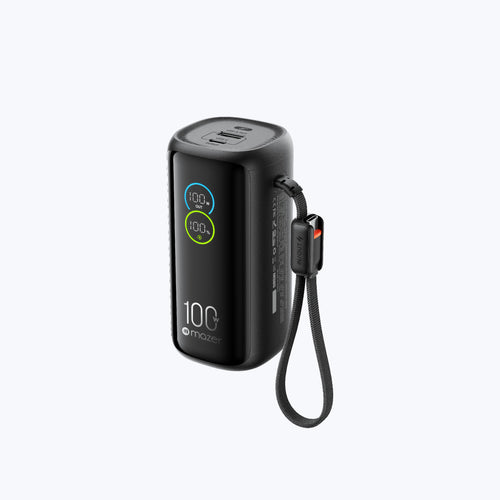
That is why we point China travellers to the MagAir31 10,000mAh Qi2.2 Certified 25W power bank ($79.90 SGD). Its product page lists it as CCC Approved and UN38.3 tested, it is rated 38.5Wh (well inside the 100Wh cabin limit), and it snaps magnetically onto an iPhone for up to 25W wireless charging, with 45W from its USB-C port. At 200g it is a fair weight, but it replaces a cable and a second battery. The Black version was in stock at the time of writing; the Natural Titanium colour was sold out.

MagAir31, listed as CCC Approved, for domestic flights in China
Choosing a China travel adapter that does more than fit
China's hotels are generous with sockets compared with Japan's, but you still end up charging everything at once after a day of Alipay, WeChat, Didi and offline maps quietly draining your battery in the background.
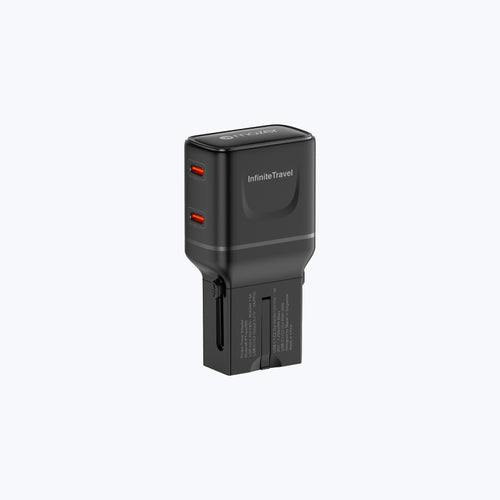
The InfiniteTravel Pocket 65W Universal Travel Charger ($59.90 SGD) suits most China trips. It ships with US, UK, EU and AU pins, so you can use the US pin for Type A slots or the AU pin for Type I, whichever half of the socket is free. A single USB-C port gives up to 65W for a laptop, or 45W plus 20W across two devices. The input is rated 100 to 240V, and it weighs 106g.
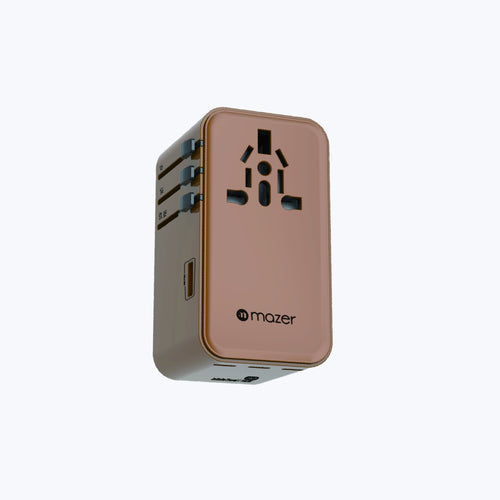
Families or work travellers juggling a laptop, tablet and two phones may want more ports. The 100W model listed for China is currently sold out, so worth checking back. In the meantime, the Infinite Travel PD160W ($129.90 SGD) offers three USB-C ports and a USB-A, with up to 140W from one port.
Before you fly to China: the checklist
Run through this at home, not in the Changi departure hall.
- Adapter: Bring US-style (Type A) or AU-style (Type I) pins; a universal charger with both covers every Chinese socket.
- Voltage: China's 220V is close to Singapore's 230V, so no converter is needed for your usual devices.
- CCC mark: If you have any domestic flight, your power bank needs a clear CCC (3C) logo printed on it.
- Capacity: Keep each power bank at or under 100Wh, which covers almost every 10,000mAh and 20,000mAh model.
- Quantity: Pack no more than two power banks, both in your cabin bag, under Singapore's 2026 rules.
- Apps: Charge fully before landing, because payment and ride-hailing apps leave little room for a flat phone.
On that last flight leg out of Singapore, the Civil Aviation Authority of Singapore's April 2026 bulletin limits passengers to two power banks, bans them from checked baggage, and says they must not be charged on board. It aligns with IATA's passenger lithium battery guidance, which keeps spare batteries in carry-on and requires airline approval above 100Wh.
Useful vocabulary if you need to buy something locally: a travel adapter in Chinese is 转换插头 (zhuǎnhuàn chātóu), and a power bank is 充电宝 (chōngdiànbǎo).
Sort the plug, then sort the power bank
China is easy on voltage and only mildly annoying on plugs. A charger with US and AU pins handles every socket you will meet, and your 230V habits carry over. The real trap is the power bank. If your itinerary includes a domestic flight, the CCC mark decides whether your battery boards with you or stays at security. Pair the InfiniteTravel Pocket 65W with a CCC-marked power bank like the MagAir31 and both problems are solved before you leave home. Travelling with a family's worth of devices? The Infinite Travel PD160W charges four at once from one socket. You can compare the full range in the Mazer travel adapter collection.
TL;DR
A China travel adapter needs US-style Type A or AU-style Type I pins, since mainland sockets do not take Singapore's Type G, but China's 220V means no voltage converter. If you fly domestically in China, your power bank must carry a clear CCC (3C) mark, a rule in force since 28 June 2025. Keep power banks in your cabin bag and under 100Wh.
Frequently Asked Questions about China Travel Adapters and Power Banks
The questions below cover what Singapore travellers search for most before a China trip.
1. Do I need a travel adapter for China from Singapore?
Yes. Mainland China uses Type A and Type I sockets, and Singapore's three-pin Type G plug does not fit either. A universal travel charger with US and AU-style pins covers both. Hong Kong is the exception, since it uses Type G like Singapore.
2. Do I need a voltage converter for China?
No, for most travellers. China runs at 220V and 50Hz, very close to Singapore's 230V and 50Hz. Devices rated 100 to 240V or 220 to 240V work normally, so you only need a plug adapter to fit the socket.
3. Can I bring a power bank to China?
Yes, in your carry-on. For international flights into China, your airline's rules and international lithium battery limits apply. For domestic flights within mainland China, the power bank must carry a clear CCC (3C) certification mark and must not be a recalled model.
4. What is the CCC mark on a power bank?
CCC, or China Compulsory Certificate, is China's mandatory product safety certification, also called 3C. On a power bank it shows the model has passed Chinese safety testing. Since 28 June 2025, it has been required for power banks on domestic flights in China.
5. What is the power bank limit on China flights?
Power banks up to 100Wh are generally allowed in carry-on luggage, while 100Wh to 160Wh usually needs airline approval and anything above 160Wh is not allowed. Domestic flights also require the CCC mark. Your airline may set a lower quantity limit.
6. Will airport security in China take my power bank?
On domestic flights, it can be confiscated if it has no CCC mark, an unclear mark, or belongs to a recalled batch. Checking the label before you travel, and carrying a CCC-marked power bank, avoids losing it at the security checkpoint.
7. What plug sockets will I find in Chinese hotels?
Most hotels use a five-hole combination socket: a two-slot Type A section and a three-slot angled Type I section. Some older or international hotels also have universal sockets that accept round-pin plugs, but you should not rely on finding them.
8. How do you say travel adapter in Chinese?
A travel adapter is 转换插头 (zhuǎnhuàn chātóu), which translates as "conversion plug". A power bank is 充电宝 (chōngdiànbǎo). Showing these words on your phone at a convenience store or electronics shop usually gets you to the right shelf quickly.
9. Does an Australian plug work in China?
Generally yes for the shape. Australian and Chinese Type I plugs share the same angled flat-pin layout, so an AU-style pin fits the three-slot section of most Chinese sockets. China's voltage is also close to Australia's, so chargers work normally.
Get 15% off your first order
Heading to China soon? Sign up for the Mazer mailing list for 15% off your first order, plus travel charging tips and new product updates in your inbox.
About Mazer
Founded in 2010, Mazer is a Singapore-based brand trusted by over 500,000 customers, with 1.8M+ units sold, offering high-quality, smarter, and eco-friendly technology designed for everyday life #mazer
Shop this guide
More guides like this

Safety & Battery Tech
Apple MagSafe Battery Alternatives in Singapore: Qi2 and Qi2.2 Compared

Safety & Battery Tech
What Is a CCC Certified Power Bank and Why It Matters in Singapore
Join our community
Get early access to new products, exclusive deals, and free product trials.