


Chargers & Cables
Chargers & Cables
GaN vs Traditional Chargers: Is the Upgrade Actually Worth It?
What is a GaN charger, and is it worth it? We compare GaN and traditional silicon chargers on size, heat, speed and price, and say who should upgrade.

A GaN charger uses gallium nitride instead of silicon in its power circuitry, which lets it run cooler and switch faster, so the same wattage fits into a much smaller body. The upgrade is worth it if you charge a laptop, carry more than one device or travel often. If you only top up earbuds and a watch, a traditional charger will do the same job for less, because GaN does not make a slow device charge any faster.
Below, we put GaN and traditional silicon chargers side by side on the things you actually notice: size, heat, charging speed, multi-device use and price. Then we say plainly who should switch and who can skip it. Mazer has been building chargers in Singapore since 2010 for more than 500,000 customers, and every charger we sell carries a 24-month warranty, so we have seen both types fail and both types last.
What Is a GaN Charger, and What Is a Traditional One?
Open the drawer next to any HDB sofa and you will find the traditional kind. A chunky white brick, slightly warm even when nothing is plugged in, often bundled with a laptop from five years ago. Inside, silicon transistors convert 230V mains power into the low voltage your device wants. Silicon has done this job for decades. It is cheap, proven and perfectly safe.
A GaN charger does the same conversion with transistors made from gallium nitride, a "wide bandgap" semiconductor. The US Department of Energy's wide bandgap semiconductors factsheet explains that these materials operate at frequencies at least 10 times higher than silicon devices and allow power electronics to be "smaller, faster, more reliable, and more efficient." Higher switching frequency is the key. It lets designers use smaller transformers and capacitors, which are the bulkiest parts in any charger.
Why "GaN" on the box is not a speed promise
This trips people up. GaN describes how the charger is built, not how fast it charges. Charging speed is set by the wattage and the protocol, usually USB Power Delivery, plus what your device is willing to accept. A 20W GaN charger and a 20W silicon charger will charge an iPhone at the same speed. The GaN one is just smaller.
GaN Charger vs Traditional Charger: The Differences That Matter
Size and weight
This is the headline benefit. Texas Instruments, which makes power chips for adapter manufacturers, says its GaN devices can reduce the solution size of a typical 67W power adapter by as much as 50% compared with silicon. In your hand, that is the difference between a brick and something closer to a matchbox. Our AiPrestigeGaN 65W, for example, measures about 58 x 58 x 31mm and weighs 127g, while delivering enough power for a MacBook Air.
Heat and efficiency
Every charger wastes some energy as heat. GaN wastes less. TI quotes up to 94% system efficiency for its GaN designs under 75W. Less waste means a cooler charger on the desk, and a cooler charger can be packed into a smaller shell without overheating. Honestly, this is the benefit people do not expect, then notice every evening when they unplug.
Charging speed
At equal wattage, there is no difference. Where GaN changes the picture is that higher wattages become practical to carry. A 65W silicon charger is often too bulky to bother packing. A 65W GaN charger slips into a jacket pocket, so you end up using the fast option more often.
Multi-device charging
Because GaN frees up space inside the case, it is easier to fit two or three ports with smart power sharing. One GaN fast charging brick can handle a laptop and a phone together, which a traditional single-port brick cannot.
Price
Silicon still wins on cost at low wattages. At 65W and above, the price gap narrows, and replacing two or three old bricks with one GaN charger usually works out cheaper overall.
| Factor | GaN charger | Traditional silicon charger | Who wins |
|---|---|---|---|
| Size at 65W | Up to about 50% smaller (TI, 67W design) | Larger transformer and heatsink | GaN |
| Efficiency | Up to 94% system efficiency under 75W (TI) | More energy lost as heat | GaN |
| Charging speed at the same wattage | Same | Same | Draw |
| Multi-port at 65W and above | Common, compact | Rare, bulky | GaN |
| Price at 20W or below | Slightly higher | Lower | Traditional |
| Earbuds, watches, slow devices | No speed benefit | No speed benefit | Draw (buy cheaper) |
Table: GaN vs traditional silicon chargers by the factors buyers actually notice (efficiency and size figures from Texas Instruments)
Where a GaN Charger Does Not Help
Being fair about this matters. If the only things on your nightstand are wireless earbuds and a smartwatch, GaN gives you nothing extra. Those devices draw a few watts and charge at their own pace no matter what brick sits behind them. The same goes for an old phone that predates fast charging, or a Kindle. Keep the charger you have.
GaN also does not fix a bad cable. A 65W GaN charger paired with a thin 60W cable will still top out at 60W, and a cracked cable from Lazada will charge slowly whatever it is plugged into. Finally, GaN does not change how your battery ages. Heat inside the phone and time spent at 100 percent matter far more than what the charger is made of.
Quick checklist: should you switch to GaN?
- Laptop charging: if you charge a USB-C laptop, a 65W or higher GaN charger is the most noticeable upgrade you can make.
- Device count: if you charge two or more devices daily, one multi-port GaN charger replaces several bricks.
- Travel frequency: if you fly through Changi more than a few times a year, the weight and size savings add up fast.
- Slow devices only: if you only charge earbuds or a watch, stay with silicon and save the money.
- Cable quality: if your cable is rated 60W or lower, upgrade it alongside any charger above 60W.
Picking a GaN Charger That Fits How You Charge
Think about a weekend trip to Bangkok. Phone, laptop, maybe a tablet for the flight. With traditional chargers that is three bricks and a tangle. With GaN it is one.

GaNPrestige Slim 65W with interchangeable travel pins
For that kind of trip, the GaNPrestige Slim 65W with Travel Pins ($43.90 SGD) is a sensible pick. Its USB-C port delivers up to 65W on its own, its USB-A port handles a second device, and it comes with interchangeable UK, EU and AU pins. When both ports are in use it splits 45W and 12W, so the laptop still gets the lion's share.
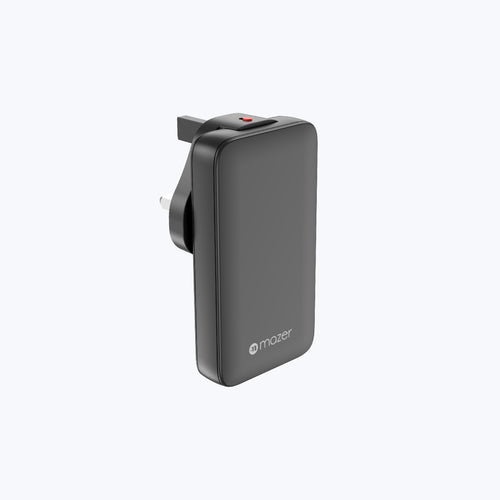
If you mainly need a fast phone charger, you do not need 65W. The PrestigeGaN V6 35W ($19.90 SGD) uses GaN7 in a compact UK plug body, offers up to 35W over USB-C Power Delivery, and covers iPhones, Galaxy phones and even a Nintendo Switch.

PrestigeGaN V6 35W GaN wall charger with UK plug
The Verdict on GaN vs Traditional Chargers
GaN is not magic, and it is not a speed upgrade by itself. It is a packaging upgrade: the same power, less heat, far less bulk. That makes it the clear winner for laptops, multi-device setups and frequent travellers, and an optional extra for anyone charging only small, slow gadgets. If you are replacing a laptop brick or carrying more than one charger, switch. If not, keep what works. Start with the AiPrestigeGaN 65W with AI Display ($59.90 SGD) for a three-port desk and travel setup, or compare wattages in our chargers collection.
TL;DR
What is a GaN charger? It is a charger built with gallium nitride instead of silicon, so it runs cooler and can be up to about half the size of a traditional charger at the same wattage. Upgrade if you charge a laptop or several devices, and skip it if you only charge earbuds and watches.
Frequently Asked Questions about GaN Chargers
Quick answers to the questions people ask most before swapping an old charger for a GaN one.
1. What is a GaN charger?
A GaN charger is a wall charger that uses gallium nitride transistors instead of silicon. Gallium nitride switches faster and wastes less energy as heat, so manufacturers can fit the same power into a smaller, lighter body.
2. Does a GaN charger charge faster than a normal charger?
Not at the same wattage. Charging speed depends on wattage, the charging protocol and the device. A 20W GaN charger and a 20W silicon charger charge a phone equally fast, but GaN makes higher-wattage chargers small enough to carry daily.
3. Is a GaN charger safe for my phone?
Yes. A GaN charger that follows USB Power Delivery only supplies the voltage your phone requests. Look for built-in protection against over-current, over-voltage, overheating and short circuits, which reputable GaN chargers include.
4. Why are GaN chargers smaller?
Gallium nitride can switch at much higher frequencies than silicon, which allows smaller transformers and capacitors inside the charger. It also loses less energy as heat, so it needs less space for cooling and fits in a compact shell.
5. What is the difference between fast charging and normal charging?
Fast charging raises voltage or current, usually through USB Power Delivery, to push more watts into the battery early in the charge. Normal charging stays at about 5V and 5W to 12W. Fast charging slows itself down as the battery fills.
6. Is a GaN charger worth it for an iPhone only?
It can be, mainly for size. A 20W to 35W GaN charger fast charges an iPhone at the same speed as a silicon brick of equal wattage but is smaller. If you already own a working 20W charger, there is little reason to replace it.
7. Do GaN chargers get hot?
They get warm under heavy load, like any charger, but they waste less energy as heat than silicon chargers of the same wattage. A GaN charger feeling warm while powering a laptop is normal; one that is too hot to touch is not.
8. How long do GaN chargers last?
A well-made GaN charger should last as long as a good silicon charger, typically several years of daily use. Choose a brand with a clear warranty and local support, such as a 24-month warranty, so a fault does not leave you stuck.
Get 15% off your first order
Ready to retire the old bricks? Join the Mazer mailing list for 15% off your first order, plus straightforward guides on GaN, cables and travel charging delivered to your inbox.
About Mazer
Founded in 2010, Mazer is a Singapore-based brand trusted by over 500,000 customers, with 1.8M+ units sold, offering high-quality, smarter, and eco-friendly technology designed for everyday life #mazer
Shop this guide
More guides like this

Chargers & Cables
Best Chargers for iPad and Tablets in Singapore

Chargers & Cables
Best Chargers for MacBook Air and MacBook Pro in Singapore
Join our community
Get early access to new products, exclusive deals, and free product trials.