



Chargers & Cables
Chargers & Cables
How to Identify a Fast Charger (And Spot a Fake)
How to identify a fast charger in Singapore: read the output label, check the SAFETY Mark number on the official register, and spot fake chargers before you buy.

The quickest way to identify a fast charger is to read the tiny output line printed on the plug, not the box. If it lists only 5V (for example 5V 2.1A), it is a standard charger; if it lists higher voltage steps such as 9V, 15V or 20V alongside USB Power Delivery (PD), it can fast charge. To spot a fake, check that the SAFETY Mark registration number actually exists on Singapore's official register.
This guide walks through four myths we hear constantly, from "fast charge on the box means fast" to "a fake will look obviously fake", and corrects each one with real numbers you can check in under a minute. You will learn to decode an output label, tell whether a cable is holding you back, and know what OEM really means. We have been designing chargers in Singapore since 2010, for more than 500,000 customers, and every one carries a 24-month local warranty, so we have opened, tested and returned more chargers than most.
Myth 1: "If the box says fast charge, it is a fast charger"
Picture a pasar malam stall at the edge of an HDB void deck. A row of white bricks, each with a sticker shouting FAST CHARGE in red. Three for ten dollars. The sticker costs a fraction of a cent to print, and it tells you nothing.
Fast charging is a negotiation, not a slogan. When you plug in, the phone and the charger talk over the USB-C cable using a protocol called USB Power Delivery. The phone asks for a higher voltage, the charger confirms it can supply it safely, and only then does the power step up from the basic 5V. If the charger cannot hold that conversation, your phone falls back to slow charging, whatever the packaging promised.
How to identify a fast charger from the output label
Turn the charger over. Somewhere in grey moulded text you will find "Output", followed by voltage (V) and current (A) pairs. Multiply them and you get watts. That single line answers most questions.
| Output line on the label | Watts | What it means |
|---|---|---|
| 5V 1A | 5W | Old phone cube. Slow, not fast charging |
| 5V 2.1A | 10.5W | Standard USB-A charger. Not fast charging, despite the higher amps |
| 5V 3A / 9V 2.22A (USB-C PD) | 20W | Entry-level fast charging for most phones |
| 5V 3A / 9V 3A / 15V 2.33A / 20V 1.75A | 35W | Phone fast charging plus tablets and light laptops |
| 5V 3A / 9V 3A / 15V 3A / 20V 3.25A | 65W | Laptop-class fast charging |
| Adds 28V 5A (USB PD 3.1) | 140W | High-power laptops such as 16-inch notebooks |
Table: Common charger output labels decoded (watts = volts x amps)
So, is 5V 2.1A a fast charger? No. It delivers about 10.5W and never moves past 5V, which is exactly the ceiling fast charging is designed to break. The tell is the voltage ladder. A genuine fast charger lists several steps (9V, 12V, 15V, 20V), and a fake that claims 65W while printing only "5V 3A" has told on itself.
For a real example, the PrestigeGaN V6 35W with USB-C cable prints 5V 3A, 9V 3A, 12V 2.9A, 15V 2.33A and 20V 1.75A on its USB-C port. Multiply the last pair and you get exactly 35W. The numbers add up, which is the whole point.
Myth 2: "A fake charger will look obviously fake"
It will not. Counterfeit chargers sold in Singapore today copy the shape, the colour of the plastic and even the fonts. Some go further and print a safety logo that was never issued to that model.
That last trick is not hypothetical. In 2019, Enterprise Singapore fined a local gadget supplier S$50,000 after finding that 22 of 30 adaptor models it sold carried SAFETY Marks that actually belonged to other, registered models. The mark was real-looking. The registration was not.
The SAFETY Mark check that takes 30 seconds
AC adaptors are one of 33 Controlled Goods under Singapore's Consumer Protection (Safety Requirements) Regulations, which means they must be registered before sale and carry the SAFETY Mark. Each mark has a unique 8-digit registration number. Enterprise Singapore's guide to looking for the SAFETY Mark explains how to enter that number, or the model number, into the official register and confirm the result matches the charger in your hand and has not expired. If the search returns a different product, or nothing at all, walk away.
Beyond the mark, here is the checklist we use when a customer brings in a charger they are unsure about.
- SAFETY Mark number: Search the 8-digit number on the official register and make sure the model listed matches your charger.
- Output label: Confirm the voltage steps multiply out to the wattage on the box, with no 65W claim sitting on a 5V-only label.
- Print quality: Genuine labels are crisp and consistent, while fakes often show blurred text, spelling slips or uneven spacing.
- Weight and feel: A charger that feels oddly light or rattles may be missing internal components that handle heat and surge protection.
- Price sanity: A "65W" charger selling for the price of a kopi and kaya toast set is rarely what it claims.
- Seller and warranty: Buy from the brand's official store or an authorised retailer that offers a written local warranty you can actually claim.
- Certification logos: USB-IF certified chargers support USB PD with PPS, and the logo should appear on packaging or product briefs from a traceable seller.
On that last point, the USB Implementers Forum explains that its Certified USB Fast Charger programme covers chargers that support the Programmable Power Supply (PPS) feature of USB PD 3.0. PPS matters because many Android phones, including Samsung's Super Fast Charging, rely on it.
Myth 3: "Any USB-C cable will fast charge"
You can own a perfectly good charger and still crawl along at a fraction of its speed, because the cable is the bottleneck. It happens all the time. The charger is blamed, the cable gets a free pass.
Standard USB-C cables are rated for up to 60W (3A). Anything above that, such as 100W or 240W, needs a cable with an e-marker chip that tells the charger it can safely carry 5A. Without one, a 140W charger politely limits itself.
How to know if a cable is fast charging
Check the packaging or product page for a wattage rating and an e-marker mention. Then test it: on an iPhone or Android phone, a fast-charging setup usually shows a noticeable jump in percentage within the first 15 to 30 minutes. Some chargers with a display, like the AiPrestigeGaN 65W, show real-time charging status and port usage, so you can see straight away whether the port is working hard or idling.

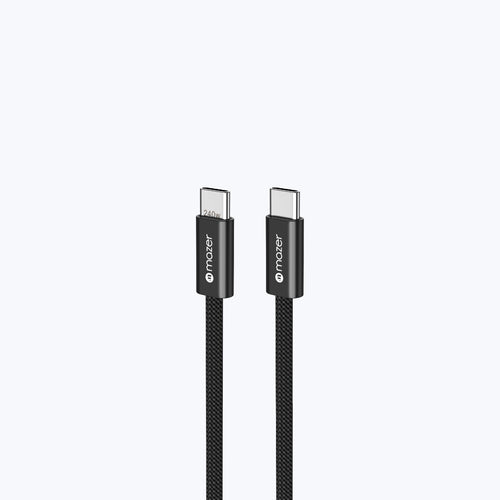
InfiniteFLEX2 Pro USB-C to USB-C 240W braided cable
For a cable that will never be the weak link, the InfiniteFLEX2 Pro 240W braided cable carries a certified e-marker chip and supports up to 240W with a compatible charger, at $9.90 SGD. Its data speed is USB 2.0 (480Mbps), so treat it as a charging cable rather than a fast file-transfer cable. One last thing on Android: Samsung Galaxy phones have a Fast charging switch under Settings, Battery, Charging settings. If it is off, even the right charger and cable will charge slowly.
Myth 4: "OEM means original"
This one causes real confusion on Carousell. OEM stands for Original Equipment Manufacturer, the factory that builds a product for a brand. A genuine OEM charger is the one that shipped in the box or is sold by the phone brand itself. But sellers often use "OEM" loosely to mean "made in the same factory" or "same quality as original", which is a claim no buyer can verify.
So, what is an OEM charger worth on a listing? Very little, unless the seller can show a matching SAFETY Mark registration and a receipt trail. If you are hunting for an authentic Samsung or Apple charger, buy from the brand's own store or an authorised retailer. If you want a third-party charger, choose a brand that publishes full output specs, registers its products and stands behind them locally.

AiPrestigeGaN 65W with smart display
That is where transparency pays off. The AiPrestigeGaN 65W with AI display publishes every port profile (up to 20V 3.25A on USB-C), supports PD 3.2 and QC on its USB-A port, and lists its multi-port splits, such as 45W plus 20W across both USB-C ports. It weighs 127g and sells at $59.90 SGD. Nothing hidden, nothing rounded up.
Why a local warranty is the final fake filter
Counterfeiters cannot offer a warranty they will honour, because they will not be there in six months. That is the real test. A 24-month local warranty means a Singapore team you can reach, a replacement process you can use, and a brand with a reason to get the label right in the first place. Every Mazer charger carries one. When you are ready to upgrade, browse the full range of Mazer chargers, read the output line before you buy, and keep the receipt. Old habits from the pasar malam stall can stay there.
TL;DR
To identify a fast charger, read the output label: real fast chargers list voltage steps above 5V (9V, 15V, 20V) with USB PD, while 5V 2.1A is standard charging. Spot a fake by searching the SAFETY Mark's 8-digit number on Singapore's official register, checking that the label maths adds up, and buying only where a local warranty is honoured.
Frequently Asked Questions about Identifying Fast Chargers
These are the questions Singapore shoppers ask most when checking a charger's speed and authenticity. Each answer stands on its own.
1. How do I identify a fast charger?
Look at the output line printed on the charger. A fast charger lists several voltage steps above 5V, such as 9V, 15V or 20V, usually with USB Power Delivery. A charger that only lists 5V output is a standard charger, regardless of what the packaging says.
2. Is 5V 2.1A a fast charger?
No. 5V 2.1A works out to about 10.5W, which is standard charging. Fast charging raises the voltage, typically to 9V or higher, so a 20W USB-C PD charger delivering 9V 2.22A charges a modern phone noticeably faster than a 5V 2.1A brick.
3. How do I know if my cable supports fast charging?
Check its wattage rating. Standard USB-C cables handle up to 60W, which covers phone fast charging. For 100W or 240W laptop charging, you need a cable with an e-marker chip. If charging feels slow with a good charger, swap the cable first.
4. What is an OEM charger?
OEM stands for Original Equipment Manufacturer. A true OEM charger is the one sold by your device's brand. Online listings often use "OEM" loosely to mean a copy from a similar factory, so treat the term as a claim, not proof, unless the SAFETY Mark registration checks out.
5. How do I check if a charger's SAFETY Mark is real?
Find the unique 8-digit registration number next to the SAFETY Mark and search it, or the model number, on Enterprise Singapore's register of controlled goods. Confirm the listed product matches your charger and that the registration has not expired.
6. How do I activate fast charging on my phone?
Most iPhones fast charge automatically with a compatible USB-C PD charger. On Samsung Galaxy phones, go to Settings, Battery, Charging settings and switch on Fast charging. Super Fast Charging on Samsung also needs a charger that supports USB PD PPS.
7. Where can I buy an authentic Samsung charger in Singapore?
Buy from Samsung's own store or an authorised retailer, and keep the receipt. If you prefer a third-party PD charger with PPS support, choose a brand that registers its products, publishes full output specs and offers a local warranty you can claim.
8. Are fake chargers dangerous?
They can be. Unregistered chargers have not been tested to Singapore's safety standards, and missing internal protection can lead to overheating. That is why AC adaptors are a Controlled Good in Singapore and must carry a valid, registered SAFETY Mark before sale.
9. Does a bigger wattage charger damage my phone?
No. With USB Power Delivery, the phone requests only the power it can accept, and the charger supplies that amount. A 65W charger will charge a phone at the phone's own maximum rate, not at 65W, as long as the charger is genuine.
Get 15% off your first order
Join the Mazer mailing list and get 15% off your first order, plus plain-English guides on reading labels, picking cables and charging safely. It is the easiest way to upgrade from a mystery charger to one you can actually trust.
About Mazer
Founded in 2010, Mazer is a Singapore-based brand trusted by over 500,000 customers, with 1.8M+ units sold, offering high-quality, smarter, and eco-friendly technology designed for everyday life #mazer
Shop this guide
More guides like this

Chargers & Cables
Best Chargers for iPad and Tablets in Singapore

Chargers & Cables
Best Chargers for MacBook Air and MacBook Pro in Singapore
Join our community
Get early access to new products, exclusive deals, and free product trials.