
Travel
Travel Adapter for India, Dubai and the Middle East
India travel adapter guide for Singapore travellers: Type D sockets, why EU pins wobble, and why Dubai and the Gulf use the same Type G plug as home.

For Dubai and most of the Gulf, a Singapore traveller needs no adapter at all, because the UAE, Saudi Arabia, Qatar, Oman, Bahrain and Kuwait use the same three-pin Type G socket we have at home. India is the tricky one. Its sockets are mainly Type D and Type M, almost no universal travel adapter carries a true Type D pin, and the honest answer for an india travel adapter is a USB-C charger with an EU pin for hotel sockets plus a cheap local Type D plug as backup.
This guide walks through what actually happens at the socket in Delhi, Mumbai, Dubai and Doha, why some pins wobble and others hold, and what to pack so your phone and laptop are charged by breakfast. We are a Singapore-based charging brand, around since 2010 and trusted by over 500,000 customers, so we hear the "it fell out of the wall" stories often. Every Mazer charger also comes with a 24-month warranty. If you are still picking hardware, our travel adapters and universal chargers are a good place to compare options.
Dubai and the Gulf: Your Singapore Plug Already Fits
Picture the hotel room in Dubai Marina after a seven-hour flight from Changi. You reach for the wall, and the socket looks exactly like the one beside your bed in Tampines. Three rectangular holes, a little switch, 230 volts. That is not a coincidence.
The UAE follows the British system. According to WorldStandards' Dubai electricity guide, Type G is the official standard there, at 230V and 50Hz. Singapore is also Type G at 230V. So the charger you use at home plugs straight in, no adapter, no converter.
The same applies across most of the Arabian Peninsula. Saudi Arabia, Qatar, Oman, Bahrain and Kuwait are all listed as Type G. Saudi Arabia runs at 60Hz rather than 50Hz, which sounds alarming but makes no practical difference to a modern USB-C charger rated for 50/60Hz input.
Where Gulf travellers still get caught out
Older buildings, souk stalls and some serviced apartments occasionally have two-pin round sockets or multi-standard outlets. Rare, but it happens. And if you are connecting through Dubai to Europe or India, your next stop will not be Type G. That is the real case for packing a travel adapter on a Middle East trip: not Dubai itself, but the leg after it.
Why an India Travel Adapter Is Harder Than It Looks
Now picture a guesthouse in Jaipur. The socket has three fat round holes in a triangle. You push in your EU plug, it sits, you let go, and it slowly droops forward until the phone stops charging at 3am. Most travellers to India have a version of this story.
WorldStandards' India page explains why. India has standardised on Type D for everyday devices and Type M for heavy appliances such as fridges and washing machines, both at 230V and 50Hz. Type D has three large round pins. The common European two-pin plug (Type C) is described as "more or less compatible" with Type D sockets, but the fit can be unstable. The pins are thinner than the holes they sit in.
The universal adapter gap
Here is the part most product pages skip. Nearly every universal adapter on sale, ours included, ships with US, UK, EU and Australian pins. None of those is a true Type D. So when someone says their universal adapter "covers India", what they usually mean is that the EU pin goes into the socket. Sometimes snugly. Sometimes not.
The good news is that many Indian hotels, airports and newer offices fit hybrid or "universal" sockets that accept round two-pin plugs, UK-style plugs and Type D in one faceplate. In business hotels in Bengaluru or Mumbai you will often find these by the desk. In homestays, older guesthouses and trains, expect plain Type D.
What Actually Works in India: An Honest Setup
After enough trips, most frequent India travellers settle on the same two-part kit. It is not glamorous. It works.
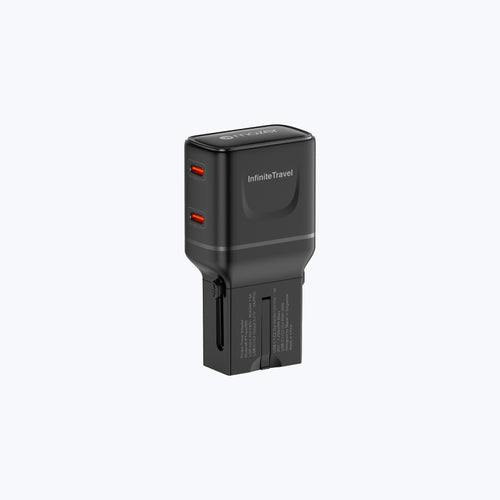
Part one is a compact USB-C charger with interchangeable pins, so you charge everything from one brick. The InfiniteTravel Pocket 65W Universal Travel Charger ($59.90 SGD) is the one we would pack for a laptop trip. It has two USB-C ports, 65W from a single port (45W plus 20W when both are in use), accepts 100 to 240V input, and weighs 106g. It comes with US, UK, EU and AU pins, and a pin lock system that holds the chosen pin firmly in place. In Dubai, use the UK pin. In an Indian hotel with a universal socket, use the EU pin.

InfiniteTravel Pocket 65W: UK pin for Dubai, EU pin for universal sockets in India
Part two is a plain Type D plug adapter, bought cheaply at most electrical shops or airport kiosks once you land. Your EU pin goes into it, and it goes into the wall, and the whole thing stops drooping. It is the least exciting thing in your bag and the one you will thank yourself for in a homestay in Kerala.
Phone-only trips
If you are travelling light with just a phone and earbuds, the InfiniteTravel Pocket 45W ($39.90 SGD) is the smaller option at 90g, with the same pin set and dual USB-C (25W plus 20W shared). It will also top up a tablet or a lightweight laptop, just more slowly.
A quick word on voltage
India, the UAE and the Gulf all run at 230 to 240V, close to Singapore. Modern phone and laptop chargers, including ours, accept 100 to 240V, so you do not need a voltage converter. The only items to check are older hair tools or kettles bought for a 110V market. Look at the small print on the plug body: if it says 100 to 240V, you are fine.
Country by Country: Plugs, Voltage and Which Pin to Use
Keep this table on your phone. It covers the destinations Singapore travellers book most often in South Asia and the Middle East.
| Destination | Plug types | Voltage / frequency | Singapore plug fits? | Pin to use on a universal charger |
|---|---|---|---|---|
| India | C, D, M | 230V / 50Hz | No | EU pin in universal sockets; add a local Type D plug for older sockets |
| UAE (Dubai, Abu Dhabi) | G | 230V / 50Hz | Yes | UK pin |
| Saudi Arabia | G | 230V / 60Hz | Yes | UK pin |
| Qatar | G | 240V / 50Hz | Yes | UK pin |
| Oman, Bahrain, Kuwait | G | 230V / 50Hz | Yes | UK pin |
| Nepal | C, D, M (most sockets universal) | 230V / 50Hz | Not reliably | EU pin |
| Maldives | C, D, G (most sockets universal) | 230V / 50Hz | Usually | UK or EU pin |
Table: Plug types and voltage for India and the Middle East, based on WorldStandards country data
Packing checklist for India and the Gulf
- Socket type: Type G for the Gulf (same as Singapore), Type D or universal sockets for India.
- Pins: Make sure your charger has a UK pin and an EU pin, and plan to pick up a Type D plug in India.
- Voltage: Check every charger says 100 to 240V on the label before you leave.
- Ports: Count your USB-C devices and pick a charger with enough ports to run them overnight.
- Wattage: Choose 65W if a laptop is coming, 45W or less for phone and earbuds only.
- Flight rules: Keep power banks in your cabin bag; chargers themselves can go in either bag.
Choosing the Right India Travel Adapter for Your Trip
The mistake is buying for the wrong country. A Gulf-only trip barely needs an adapter, so any money spent should go into a better USB-C charger rather than a bag of plugs. India needs a little more thought: a reliable EU pin, a local Type D backup, and enough output for what you carry. One charger that runs a laptop and a phone through one socket matters more in India than anywhere, because good sockets near the bed are scarce. That is why we would pack the Pocket 65W for a mixed India and Dubai itinerary, or the lighter InfiniteTravel Pocket 45W if the laptop stays home. Browse the full Mazer chargers range if you need more ports or more wattage.
TL;DR
Dubai and the Gulf use Type G sockets like Singapore, so your home charger fits without an adapter. For India, the best india travel adapter setup is a 100 to 240V USB-C charger with an EU pin, plus a cheap Type D plug bought locally for older sockets.
Frequently Asked Questions about Travel Adapters for India and the Middle East
These are the questions Singapore travellers ask most before flying to India, Dubai and the Gulf.
1. Do I need a travel adapter for Dubai from Singapore?
No. Dubai uses Type G sockets at 230V, the same three-pin standard as Singapore, so your existing chargers plug straight in. You only need an adapter if your trip continues to a country with a different socket, such as India or Europe.
2. What plug type does India use?
India mainly uses Type D, with three large round pins, for everyday devices and Type M for heavy appliances. Supply is 230V at 50Hz. Many hotels also fit universal sockets that accept two-pin round plugs and UK-style plugs.
3. Will a universal travel adapter work in India?
Usually, but not perfectly. Most universal adapters have US, UK, EU and AU pins and no true Type D pin. The EU pin fits many Indian sockets, especially universal ones, but can sit loosely in older Type D outlets.
4. Where can I buy a travel adapter for India?
Buy your main USB-C charger with interchangeable pins in Singapore before you fly, so you can test it at home. Then pick up an inexpensive Type D plug adapter at an electrical shop or airport kiosk in India for older sockets.
5. Do I need a voltage converter for India or the UAE?
Not for phones, tablets or laptops. India and the UAE run at around 230V, and most modern chargers accept 100 to 240V input. Check the label on each charger; only single-voltage 110V appliances need a converter.
6. Can I use a Type C plug in an Indian Type D socket?
Often yes, but the fit may be loose because Type C pins are thinner than Type D holes. If the plug droops or loses contact, use a local Type D adapter as a sleeve so it holds firmly.
7. What plug does Saudi Arabia use?
Saudi Arabia uses Type G sockets at 230V and 60Hz, so Singapore plugs fit. The 60Hz frequency does not affect modern USB chargers rated for 50/60Hz input, which covers nearly every phone and laptop charger sold today.
8. Which India travel plug adapter should I buy for a laptop?
Pick a USB-C charger of at least 65W with an EU pin, so one brick can run a thin laptop and a phone together. Add a local Type D plug for older sockets so the charger stays seated overnight.
9. Can I bring a travel charger in my cabin bag?
Yes. Wall chargers and travel adapters contain no battery and can go in cabin or checked bags. Power banks are different: they must stay in your cabin bag, and flights departing Singapore allow a maximum of two per passenger, per CAAS.
Get 15% off your first order
Planning a trip to India or the Gulf? Join the Mazer mailing list for 15% off your first order, plus travel charging tips before your next flight out of Changi.
About Mazer
Founded in 2010, Mazer is a Singapore-based brand trusted by over 500,000 customers, with 1.8M+ units sold, offering high-quality, smarter, and eco-friendly technology designed for everyday life #mazer
Shop this guide

More guides like this


Join our community
Get early access to new products, exclusive deals, and free product trials.