
Travel
Best Portable Charger for Travel in Singapore 2026: What Actually Flies
The best portable charger for travel in Singapore in 2026 is a flight-safe 10,000mAh magnetic power bank. Here is why capacity, watt-hours and airline rules matter.

The best portable charger for travel in Singapore in 2026 is a compact 10,000mAh power bank that clears airline rules without you having to think about it. That capacity sits at roughly 38.5 watt-hours, well under the 100Wh carry-on ceiling almost every airline uses, so it goes in your hand luggage and you board without a second look. A travel power bank this size gives you about one and a half to two full phone charges, weighs around 200g, and still slips into a jacket pocket. That is the sweet spot for most trips out of Changi.
This guide covers what to look for in a small power bank for travel, the watt-hour maths behind the flight rules, and the one change in 2026 that catches Singapore travellers off guard. Mazer has been building charging gear from Singapore since 2010, trusted by over 500,000 customers and backed by a 24-month warranty, so the picks here lean on real specs rather than marketing numbers.
The gate agent, the power bank, and the watt-hour problem
Picture the priority queue at Changi Terminal 1. The person two spots ahead gets pulled aside because the crew wants to see the rating printed on their power bank. They cannot find the number. The bag goes to one side, the queue backs up, and a 27,000mAh brick that looked like a great deal online becomes the reason they are now explaining themselves to a supervisor. This happens more than you would think, and it is almost always a capacity problem.
Here is the thing most product listings bury. Airlines do not care about mAh. They care about watt-hours, and the line that matters is 100Wh. IATA guidance for passengers allows spare batteries and power banks up to 100Wh in carry-on, generally without approval. Between 100Wh and 160Wh you need airline approval, and above 160Wh you are not boarding with it at all. Power banks always go in the cabin, never in checked luggage.
Why watt-hours, not mAh, decide what you can bring on a plane
The label brags in mAh because a bigger number sells better. The airline reads watt-hours because that is the honest measure of how much energy is packed inside. To convert, you multiply the capacity in amp-hours by the battery voltage. A 10,000mAh cell at 3.85V lands near 38.5Wh. A 20,000mAh pack sits around 74Wh. A 27,000mAh unit brushes right up against the 100Wh line, which is exactly why those big bricks get questioned.
So the good news for travellers is boring in the best way. A 10,000mAh travel portable charger is nowhere near the limit. You are not doing arithmetic at the gate, and you are not hoping a supervisor is in a good mood.
One more reason to look for the number printed on the casing itself. UN38.3 is the battery transport standard airlines rely on, and a power bank that states its watt-hour rating clearly and lists UN38.3 compliance is one you can defend in ten seconds. Mazer’s MagAir line of 10,000mAh magnetic power banks, for example, prints 38.5Wh on the unit and notes UN38.3 has passed, which is the sort of detail that turns a gate conversation into a non-event.
The 2026 rule change that trips up Singapore travellers
If you have flown this year, you may have noticed something new. A growing number of airlines now restrict using or charging a power bank during the flight, and some ask you to keep it in view rather than in the overhead bin. This tightening followed a run of in-cabin battery incidents, and IATA passenger guidance already states that recharging power banks on board is not permitted. Rules vary by carrier, so the practical move is to charge your phone from the power bank before you board or during a layover, not at 38,000 feet.
This is where a magnetic power bank quietly earns its place. Snap it to the back of a Qi2 or MagSafe iPhone at the gate, and it tops up hands-free while you queue, with nothing to plug in and nothing to stow. You get the charge in before the seatbelt sign, which is the window that actually matters now.
What actually fixes it: picking a small power bank you can forget about
The fix is not complicated. For most Singapore travellers the right answer is a 10,000mAh magnetic power bank that charges wirelessly, tops up fast over USB-C, and prints its ratings where you can see them. That covers a day of walking around a new city, a long flight, and the taxi ride to the hotel, without the weight or the paperwork of a bigger pack.
Mazer’s newer MagAir models show what that looks like in practice. The MagAir31 is a 10,000mAh unit with Qi2.2 certified 25W magnetic wireless charging and up to PD/PPS 45W over USB-C, so it can nudge a tablet or a light laptop along too, and it is CCC certified with UN38.3 passed for flight. It is on the Mazer power banks collection, though popular colours rotate in and out of stock, so check the listing for current availability. If you want the thinnest possible option for a jacket pocket, the MagAir21 trims the same 10,000mAh down to a 14.2mm ultra-slim body with Qi2 certified 15W and PD20W, priced at $73.90 SGD.

The MagAir31: 10,000mAh, Qi2.2 certified 25W wireless, CCC certified and UN38.3 passed.
What to look for in a travel power bank
- Capacity: 10,000mAh (about 38.5Wh) is the flight-friendly default; go to 20,000mAh only if you truly need multiple recharges.
- Printed watt-hours: the Wh figure and UN38.3 compliance should be visible on the casing, not hidden in a manual.
- Magnetic wireless charging: Qi2 or Qi2.2 with a strong magnet lets you top up hands-free at the gate, before any in-flight charging ban applies.
- USB-C PD output: PD20W handles phones; PD45W nudges tablets and light laptops if you carry them.
- Weight and thickness: around 200g and slim enough to pocket keeps it something you actually bring.
10,000mAh or 20,000mAh: which travel power bank size wins
If you are torn between the two common sizes, this is the honest trade. Ten thousand is lighter, pocketable, and past every flight gate without a thought. Twenty thousand doubles your recharges for long-haul or a travelling group, at the cost of weight and a bag you cannot forget you are carrying. Both stay under the 100Wh line, so this is about how you travel, not about the rules.
| What matters | 10,000mAh | 20,000mAh |
|---|---|---|
| Watt-hours | ~38.5Wh | ~74Wh |
| Flies carry-on (under 100Wh) | Yes, easily | Yes, still under the cap |
| Real phone recharges | About 1.5 to 2 full charges | About 3 to 4 full charges |
| Typical weight | Around 200g | Around 350 to 400g |
| Fits a pocket | Yes | Bag, not pocket |
| Best for | Day trips, flights, light packers | Long-haul, multiple devices, groups |
A quick side-by-side of the two common travel power bank sizes for Singapore travellers.
The takeaway for your next trip out of Changi
The best portable charger for travel in Singapore is not the biggest one, it is the one that flies without drama and charges your phone in the window before you board. For most people that is a 10,000mAh magnetic power bank with clearly printed watt-hours, Qi2 or Qi2.2 charging, and USB-C PD. Pack it in your carry-on, snap it on at the gate, and the whole watt-hour headache disappears. Browse the current line on the Mazer power banks collection and match the size to how you actually travel.
Summary
The best portable charger for travel in Singapore in 2026 is a 10,000mAh magnetic power bank, roughly 38.5Wh, which sits comfortably under the 100Wh airline carry-on limit and delivers about one and a half to two phone charges. Airlines read watt-hours, not mAh, and many now restrict in-flight charging, so a Qi2 magnetic unit you can top up at the gate is the practical pick. Go to 20,000mAh only if you genuinely need multiple recharges for long-haul or a group.
Frequently Asked Questions about travel power banks
The questions Singapore travellers ask most before flying, answered quickly.
Can I bring a power bank on a plane in Singapore?
Yes, a power bank must go in your carry-on, never checked luggage, and airlines generally allow spare batteries up to 100 watt-hours without approval. A 10,000mAh or 20,000mAh power bank is well under that ceiling.
Is a 20000mAh power bank allowed on flights?
A 20,000mAh power bank is around 74Wh, which is under the 100Wh limit, so it is generally allowed in carry-on. Keep it in the cabin and check your specific airline, since some now cap how many power banks each passenger can bring.
Is a 10000mAh power bank allowed in flight?
Yes, a 10,000mAh power bank is roughly 38.5Wh, far below the 100Wh carry-on limit, so it is the easiest size to fly with. It must still travel in your hand luggage, not checked baggage.
How do watt-hours relate to mAh?
Watt-hours measure total energy and are found by multiplying amp-hours by voltage, so a 10,000mAh cell at 3.85V is about 38.5Wh. Airlines use the watt-hour figure, which is why it should be printed on the casing.
Can I charge my phone with a power bank during a flight?
Increasingly, no. A growing number of airlines in 2026 restrict using or charging power banks in-flight, and IATA guidance says recharging power banks on board is not permitted, so top up before you board or during a layover.
What size power bank is best for travel?
For most travellers a 10,000mAh power bank is best: light, pocketable, and past every flight gate. Choose 20,000mAh only if you need three or more recharges for long-haul trips or to share among a group.
Are magnetic power banks good for travel?
Magnetic power banks are convenient for travel because they snap onto Qi2 or MagSafe phones for hands-free charging, which is useful for topping up at the gate before any in-flight charging restriction applies. Look for Qi2 or Qi2.2 certification for stable output.
How much does a good travel power bank cost in Singapore?
A quality 10,000mAh magnetic travel power bank in Singapore typically runs from around $59.90 to $99.90 SGD depending on wireless speed and certifications. Higher prices usually reflect Qi2.2 25W charging, CCC certification, or a slimmer build.
Should I put my power bank in checked or carry-on luggage?
Always carry-on. Spare lithium batteries and power banks are banned from checked baggage on passenger aircraft, and if your cabin bag is gate-checked you must remove the power bank and keep it with you.
Get 15% off your first order
Sorting out a travel power bank before your next trip? Join the Mazer mailing list to get 15% off your first purchase, plus early word on new MagAir releases and flight-friendly charging gear. It is the easy way to kit out your carry-on for less.
About Mazer
Founded in 2010, Mazer is a Singapore-based brand trusted by over 500,000 customers, with 1.8M+ units sold, offering high-quality, smarter, and eco-friendly technology designed for everyday life #mazer
Shop this guide
 MagAir31 10,000mAh Qi2.2 Certified 25W Magnetic Wireless Power Bank (CCC + QR)$79.90
 MagAir21 10,000mAh Ultra Slim Magnetic Wireless Power Bank Qi2 Certified 15W$73.90
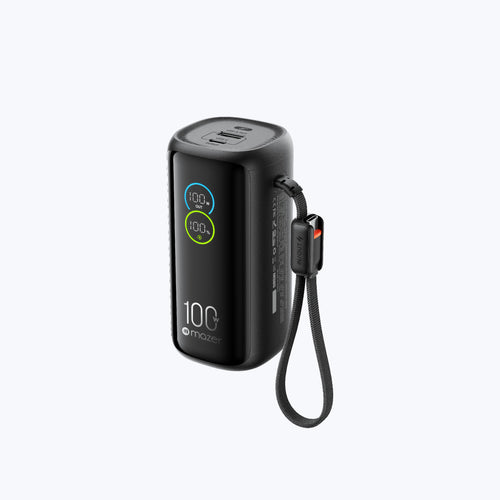 PowerCharge Link 20,000mAh PD100W Power Bank with Built-in USB-C Cable$99.90
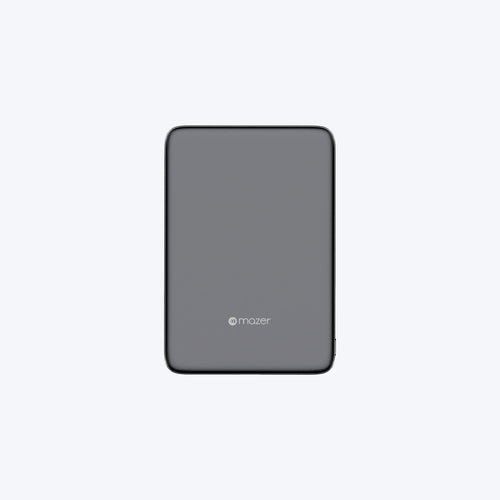 MagAir39 5000mAh Semi-Solid State Ultra Slim Magnetic Wireless Power Bank 15W (CCC + QR)$79.90
More guides like this


Join our community
Get early access to new products, exclusive deals, and free product trials.