
Travel
Travel Adapter for Japan: Type A Plugs, 100V Voltage and What to Pack
Do you need a Japan travel adapter from Singapore? Yes for the plug, rarely for voltage. Type A sockets, 100V, and what to pack, explained by Mazer.

Yes, you need a Japan travel adapter if you are flying in from Singapore, because Japanese sockets take flat two-pin Type A plugs and our three-pin Type G plugs simply will not go in. The bigger question is voltage. Japan runs on 100V, less than half of Singapore's 230V, and while almost every phone and laptop charger copes with that happily, some hair tools and small appliances do not.
This guide starts with the voltage question, because that is where trips actually go wrong (usually with a hair straightener), then covers plug shapes, how much charging power a typical Japan itinerary needs, and a short packing checklist you can screenshot before heading to Changi. We have been designing travel charging gear in Singapore since 2010, for more than 500,000 customers, and every Mazer charger mentioned here carries a 24-month warranty. Short version: one compact GaN travel charger with a US pin usually covers the whole trip.
The 100V question: will your Singapore devices work in Japan?
Picture the hotel desk in Osaka on night one. Phone at 9 percent, laptop needed for tomorrow's train bookings, and a hair straightener you bought at a Singapore mall that has never left the HDB flat before. Two of those three are almost certainly fine. The third is the one to check.
According to the Japan National Tourism Organization, the voltage throughout Japan is a uniform 100 volts, with 50Hz in eastern Japan (Tokyo, Sendai) and 60Hz in the west (Osaka, Kyoto, Nagoya). Singapore runs at 230V and 50Hz. So the electricity coming out of the wall is different, not just the hole it comes out of.
Chargers: almost always fine
Look at the small print on any phone charger, laptop brick or USB-C travel charger. If it says "Input: 100 to 240V, 50/60Hz", it is dual voltage and works anywhere in Japan with nothing more than a plug that fits. Modern chargers are built this way precisely so travellers do not need converters. The Mazer InfiniteTravel Pocket range, for example, is rated 100 to 240V on the input side, so Tokyo's 100V is well within range.
Hair tools and appliances: read the label
This is where people get caught. Many hair dryers, curling irons and straighteners sold in Singapore are rated 220 to 240V only. Plug one into 100V (through an adapter, so it physically fits) and it will run weak and lukewarm, or not at all. A plug adapter does not change voltage. If the label does not include 100V, you need a step-down transformer, or you leave it at home. Most Japanese hotels provide a hair dryer anyway, which is honestly the easier option.
Japan travel adapter plug types: Type A, Type B and why yours will not fit
Japan uses the same plug family as the United States. WorldStandards' Japan page lists Type A (two flat pins, no earth) and Type B (two flat pins plus a round earth pin). In practice, the sockets you meet in hotel rooms, ryokan, cafés and on the newer shinkansen are overwhelmingly two-pin Type A. Three-pin Type B sockets exist but are rarer, so a three-prong plug may have nowhere to go.
That makes your Singapore plug the wrong shape twice over. Type G has three thick rectangular pins, and nothing in a Japanese wall is built to receive it. What you want is something with a US-style two-flat-pin plug, which slots straight into Type A.
Two small but useful details. First, hotel sockets often sit low behind a bedside table or a desk, so a chunky adapter that sticks out sideways can be awkward. Second, many hotel rooms have only one or two free outlets, and the kettle usually claims one of them. One charger with several ports beats a bag of single adapters every time.
| Item | Singapore | Japan | What it means for you |
|---|---|---|---|
| Plug type | Type G (three rectangular pins) | Type A (two flat pins), some Type B | You need a US-style plug or adapter |
| Voltage | 230V | 100V | Check device labels for "100 to 240V" |
| Frequency | 50Hz | 50Hz east, 60Hz west | Irrelevant for chargers rated 50/60Hz |
| Phone and laptop chargers | Usually 100 to 240V | Work on 100V | Plug adapter only, no converter |
| Single-voltage hair tools | Often 220 to 240V only | Will underperform or fail | Step-down transformer, or use the hotel's |
Table: Singapore vs Japan electricity at a glance
Japan travel adapter wattage: how much charging power do you need?
A typical day in Japan is brutal on batteries. Google Maps running for hours between Shibuya and Shimokitazawa, a Suica card in your phone wallet, photos in Arashiyama, translation apps at every menu. Then everything comes back to the room flat at the same time.
The useful question is not "which adapter" but "how many devices, and how fast do I need them topped up before tomorrow's 8am train". Apple's own guidance on Mac power adapters lists 30W to 70W adapters for recent MacBook Air models and 67W to 96W for the 14-inch MacBook Pro, which gives a decent sense of scale. A phone sits comfortably at 20W to 30W.
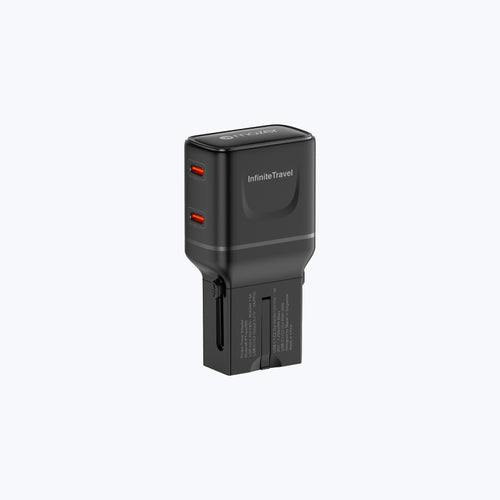
For most couples or solo travellers carrying a phone, earbuds and a light laptop, 65W from one compact brick is the sweet spot. That is why the InfiniteTravel Pocket 65W Universal Travel Charger ($59.90 SGD) is our usual suggestion for Japan. A single USB-C port delivers up to 65W, enough for a MacBook Air at full speed, and when you plug in two devices it splits into 45W plus 20W, so the laptop and the phone both charge properly overnight. It comes with US, UK, EU and AU pins and a pin-lock system, so the US pin stays put in a loose ryokan socket instead of sagging out at 2am. At 106g and 84.5 x 46 x 27mm, it disappears into a jacket pocket.

InfiniteTravel Pocket 65W with swappable travel pins
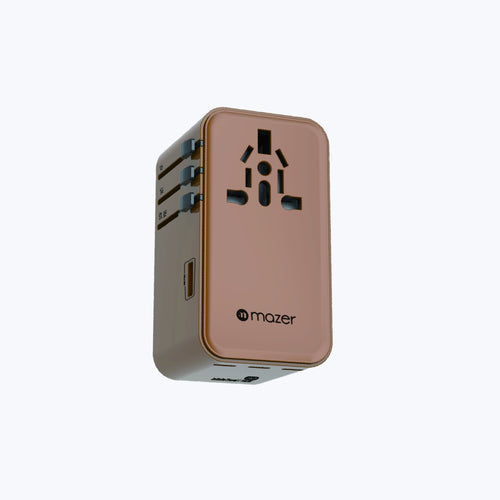
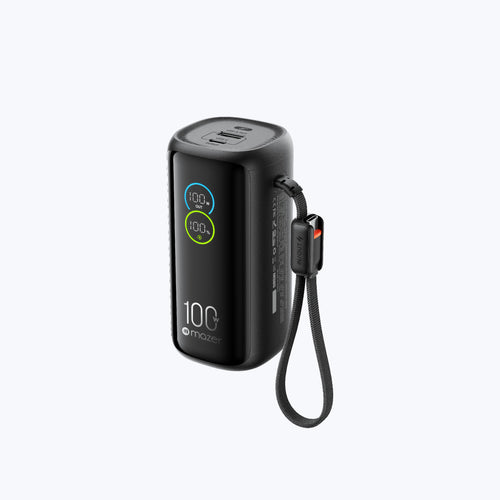
Travelling light with just a phone and earbuds? The InfiniteTravel Pocket 30W ($29.90 SGD, 83g) does the job: up to 30W from its main USB-C port, which is plenty for a fast phone top-up. Families charging two phones, a tablet and a laptop from a single socket should look higher. The 100W model listed for this trip is currently sold out, so worth checking back, but the Infinite Travel PD160W ($129.90 SGD) gives you three USB-C ports plus a USB-A and up to 140W from a single port.
One honest caveat. These are USB chargers, not pass-through adapters, so they will not take the plug of your hair dryer. That is fine, since the hair dryer was the problem anyway.
What to pack for Japan: the charging checklist
The check-in queue at Changi Terminal 1 is a bad place to discover your power bank is in the checked bag. Run through this the night before.
- Plug: One travel charger with a US-style two-flat-pin plug for Japan's Type A sockets.
- Voltage: Every charger and gadget label should read 100 to 240V; anything 230V-only stays home.
- Wattage: Add up what charges overnight; 30W covers a phone, 65W covers a phone plus a light laptop.
- Ports: Count devices against ports, because hotel rooms rarely have more than one or two free sockets.
- Cables: Pack a USB-C cable for each device you will charge at the same time.
- Power bank: Carry-on only, and a maximum of two per person under Singapore's latest rules.
That last point matters more than it used to. The Civil Aviation Authority of Singapore's April 2026 safety bulletin limits passengers to two power banks, keeps them out of checked baggage, and says power banks must not be charged on board. Banks up to 100Wh are fine in the cabin; 100Wh to 160Wh needs airline approval. Charge everything at the hotel, not at 35,000 feet.
If you forget an adapter entirely, Japan's electronics stores (Bic Camera, Yodobashi Camera, and the shops around Akihabara) sell conversion plugs. You will pay tourist-zone prices and lose half a morning, but it is fixable.
One charger, sorted before you fly
The Japan plug problem looks like a shape problem, but the real decision is voltage first, then power. Check every label for 100 to 240V, leave single-voltage hair tools behind, and bring one compact charger with a US pin and enough wattage for everything that charges overnight. For most Singapore travellers, that is the InfiniteTravel Pocket 65W: one socket, a phone and a laptop, done before the first train. Travelling as a family with four or more devices? The Infinite Travel PD160W handles the whole room from one outlet. If you are heading somewhere else after Japan, the same pins cover the UK, Europe and Australia too. Browse the full Mazer travel adapter collection to compare wattages before your trip.
TL;DR
A Japan travel adapter is essential for Singapore travellers because Japan uses two-pin Type A sockets at 100V, not Type G at 230V. Chargers rated 100 to 240V work with just a plug adapter, while single-voltage hair tools need a transformer or should stay home. A compact 65W GaN travel charger with a US pin covers a phone and laptop from one socket.
Frequently Asked Questions about Japan Travel Adapters
These are the questions Singapore travellers ask most before a Japan trip, answered briefly.
1. Do I need a travel adapter for Tokyo?
Yes. Tokyo, like the rest of Japan, uses two-pin Type A sockets, and Singapore's three-pin Type G plugs will not fit. Bring an adapter or travel charger with a US-style flat two-pin plug. Most phone and laptop chargers need nothing else.
2. What kind of travel adapter do I need for Japan from Singapore?
You need one that converts to a US-style Type A plug with two flat pins. A universal travel charger with interchangeable pins is the most practical choice, because the same unit also works in the UK, Europe and Australia on later trips.
3. Do I need a voltage converter for Japan?
Usually not for electronics. Japan runs at 100V, and chargers labelled 100 to 240V handle it without issue. You only need a step-down transformer for single-voltage appliances, typically hair dryers or straighteners rated 220 to 240V only.
4. Can I use my Singapore hair dryer in Japan?
Only if its label includes 100V. Many Singapore hair dryers are 230V-only and will run weakly or not at all on Japan's 100V supply, even with a plug adapter. Most Japanese hotels supply a hair dryer, which is usually the simpler option.
5. Are Japanese sockets two-pin or three-pin?
Mostly two-pin. Type A sockets with two flat pins are standard in hotels and homes. Three-pin Type B sockets with an earth pin exist but are less common, so a two-pin plug is the safer choice for travel.
6. Does the 50Hz and 60Hz difference in Japan matter?
Not for chargers. Eastern Japan uses 50Hz and western Japan uses 60Hz, but chargers marked 50/60Hz work in both. Some clocks and older motor-driven appliances may run slightly differently, which rarely affects travellers.
7. Can I buy a travel adapter in Japan?
Yes. Electronics stores such as Bic Camera and Yodobashi Camera, plus shops in Akihabara in Tokyo and Nipponbashi in Osaka, sell conversion plugs. It costs time and often more money, so packing one from Singapore is easier.
8. Can I bring a power bank on my flight to Japan?
Yes, in your cabin bag only. Under Singapore's April 2026 rules, you can carry up to two power banks, each up to 100Wh without approval, and they must not be charged on board. Check your airline for any stricter limits.
9. Is a universal travel adapter worth it for Japan?
Yes, if you travel more than once a year. A universal charger with swappable pins covers Japan's Type A today and the UK, Europe or Australia later, so you buy one device instead of a drawer full of single-country adapters.
Get 15% off your first order
Planning a Japan trip? Join the Mazer mailing list and get 15% off your first order, along with travel charging tips and new product updates delivered to your inbox.
About Mazer
Founded in 2010, Mazer is a Singapore-based brand trusted by over 500,000 customers, with 1.8M+ units sold, offering high-quality, smarter, and eco-friendly technology designed for everyday life #mazer
Shop this guide

More guides like this


Join our community
Get early access to new products, exclusive deals, and free product trials.