


Chargers & Cables
Chargers & Cables
Best USB-C Chargers in Singapore for iPhone, Samsung and MacBook
Not all USB-C chargers are equal. A plain-English guide to picking the best USB-C charger in Singapore for your iPhone, Samsung, or MacBook, with the specs that matter.

The best USB-C charger in Singapore is the one that matches how much power your specific device pulls, not the one with the biggest number on the box. An iPhone tops out around 27 to 30W. A Samsung S25 Ultra can hit 45W, but only with a charger that supports PPS. A MacBook Pro can ask for close to 96W. One good multi-port GaN charger covers all three, so the real skill is reading three specs correctly: wattage, PD, and PPS.
This guide skips the hype and walks through what actually changes your charge speed, which is useful whether you are topping up on the MRT or running a laptop at a hot desk. Mazer has been building charging gear from Singapore since 2010, trusted by over 500,000 customers, and every charger here is backed by a 24-month warranty. Read on and you will never overpay for wattage your phone cannot use again.
Myth 1: All USB-C chargers are basically the same
They share a plug shape. That is where the sameness ends. USB-C is a connector, not a promise about power. Two chargers with the same port can behave completely differently, because what matters is the protocol running underneath. The USB Implementers Forum, the body that defines these standards, is clear that the shape of the connector tells you nothing about the features a given port supports.
So a 5W plug and a 100W GaN charger can wear the identical USB-C port. Plug your MacBook into the 5W one and it will crawl, or refuse to charge while in use. The connector fit you, the power did not. This is why "it fits, so it works" is the most expensive assumption in charging.
Myth 2: A higher-wattage charger charges your phone faster
Your phone decides how much power it takes, not the charger. A 100W charger will not force 100W into an iPhone that only asks for 27. It negotiates, the phone requests, and the charger supplies up to that ceiling. Beyond your device’s limit, extra wattage just sits unused.
That is why the real peak each device pulls matters more than any marketing figure on the charger.
The practical read: a 30W charger already maxes out most iPhones and a MacBook Air. Paying for 100W to charge a phone changes nothing except your receipt. Where higher wattage earns its keep is laptops and multi-device charging, which is a different job, covered below.
Myth 3: Any fast charger will fast-charge a Samsung
This one quietly catches a lot of Galaxy owners in Singapore. Samsung’s 45W Super Fast Charging 2.0 needs PPS, short for Programmable Power Supply. PPS is an optional feature inside the USB PD 3.0 standard that lets the charger fine-tune voltage in tiny steps as the phone charges. As Renesas explains, PPS adjusts voltage and current in small increments so charging runs cooler and more efficiently.
Here is the catch. A charger can be labelled "45W" and still lack PPS. Plug an S25 Ultra into a PD-only 45W brick and it often falls back to roughly 15 to 22W. Same wattage on the box, half the speed in your hand. For Samsung, the spec to hunt for is not just the number, it is the letters: PPS.
iPhones do not use PPS, so they charge happily on standard PD. This is exactly why "best USB-C charger for Samsung" and "best USB-C charger for iPhone" are not the same question, even though the same charger can answer both if it supports PPS.
Myth 4: One port is enough, and GaN is just marketing
Two smaller myths, one section. First, ports. If you carry a phone, earbuds and a laptop, a single-port charger means queuing your devices. A multi-port charger runs them together, though total power is shared, so a laptop on one port may leave less for the others. Always read the per-port output, not just the headline total.
Second, GaN. Gallium nitride is not a sticker, it is the semiconductor that replaced silicon inside the charger. It runs cooler and switches faster, which is why a modern 67W GaN charger is roughly the size of an old 20W brick. For anyone living out of a bag between Changi and a hotel outlet, that size difference is the whole point.

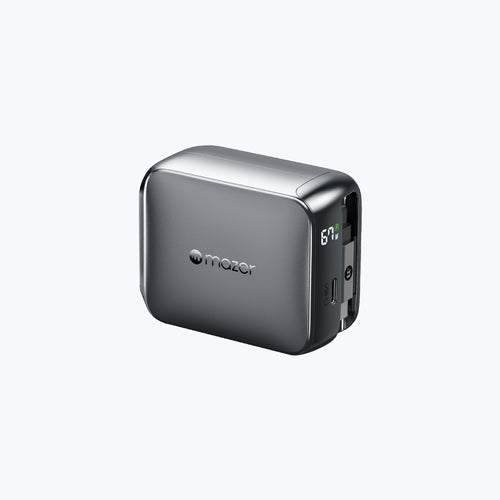
The PrestigeGaN R 67W packs GaN7, PD and PPS, and a built-in retractable cable into a foldable-plug body.
A charger like the PrestigeGaN R 67W ($59.90 SGD) is a useful worked example here. It delivers up to 67W PD and PPS, so it fast-charges an iPhone, hits Samsung’s 45W, and pushes a USB-C laptop, all from one unit. The 70cm retractable USB-C cable is built in, which is one less thing to pack. It is not about the biggest number, it is about covering every device you own with the right protocols.
What to actually match: your device to the right USB-C charger
Forget brand loyalty for a second and match the spec to the device. This is the whole guide in one table.
| Device | Peak speed it pulls | What the charger needs |
|---|---|---|
| iPhone 16 / Pro | Around 27 to 30W | Any 30W+ USB-C PD charger |
| Samsung S24 / S25 Ultra | Up to 45W | 45W with PPS, not PD alone |
| MacBook Air | Around 30 to 35W | 30W+ USB-C PD |
| MacBook Pro 14" | Up to about 96W | A 96W or higher single port |
Match the charger to what your device pulls. For Samsung, PPS is not optional if you want the full 45W.
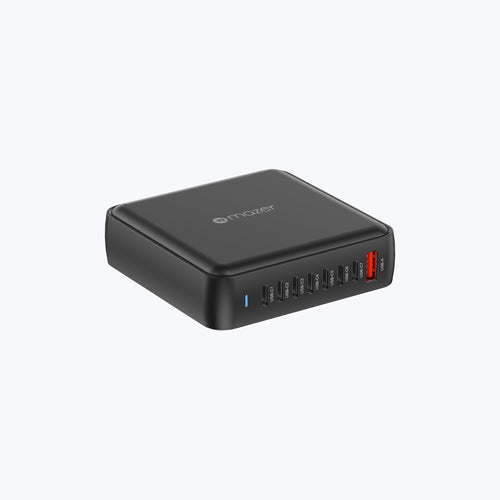
If you run several devices, a desk hub changes the maths. The GaNPrestige V5 8-in-1 Hub 170W ($99.90 SGD) offers seven USB-C ports and one USB-A, with a single port able to hit 100W for a laptop while the rest keep a phone, tablet and earbuds topped up. That is where high wattage genuinely earns its place, powering many things at once, not force-feeding one phone.

The GaNPrestige V5 170W hub: one 100W laptop port plus enough ports to clear the cable clutter on a desk.
What to look for in a USB-C charger
If you remember nothing else, screen a charger against these five points before you buy.
- Wattage that matches your device: 30W for phones, 60W+ for a laptop, 100W+ if it doubles as a laptop-and-more hub.
- PPS support for Samsung: without it, a Galaxy drops from 45W to roughly 15 to 22W, whatever the box claims.
- PD support for everything else: Power Delivery is the baseline standard iPhones, iPads and MacBooks rely on.
- Per-port output on multi-port units: the total splits across ports, so check the number each port actually gives.
- GaN for size and heat: GaN chargers run cooler and pack more power into a smaller, travel-friendly body.
The takeaway on the best USB-C charger in Singapore
The best USB-C charger in Singapore is not the highest number on the shelf, it is the one whose protocols match your devices. Meet your phone’s wattage, insist on PPS if you own a Samsung, lean on PD for Apple gear, and pick GaN so it fits your bag. One well-specced charger like the PrestigeGaN R 67W can cover an iPhone, a Samsung and a MacBook at once. Browse the full range on the Mazer chargers collection and buy for your devices, not for the marketing.
TL;DR
Not all USB-C chargers are the same, the connector shape hides the protocol underneath. To pick the best USB-C charger in Singapore, match wattage to your device (around 30W for phones, more for laptops), insist on PPS for Samsung’s 45W, rely on PD for iPhone and MacBook, and choose GaN for a smaller, cooler unit.
Frequently Asked Questions about USB-C Chargers in Singapore
Quick answers to the questions Singapore shoppers ask most before buying a USB-C charger.
1. Are all USB-C chargers the same?
No. USB-C is only the connector shape, and the real difference is the protocol and wattage underneath. A 5W plug and a 100W GaN charger can share the identical port yet charge your device at wildly different speeds.
2. What USB-C charger do I need for a Samsung S25 Ultra?
A Samsung S25 Ultra needs a 45W USB-C charger that supports PPS to reach its full Super Fast Charging 2.0 speed. A PD-only 45W charger without PPS usually drops the phone to roughly 15 to 22W.
3. Does an iPhone need a special USB-C charger?
No, iPhones use standard USB-C Power Delivery and do not require PPS. A quality 30W PD charger lets most iPhones reach their peak of around 27W, and a 20W charger is only a few minutes slower.
4. Can I use a MacBook charger to charge my phone?
Yes. A USB-C PD MacBook charger will safely charge a phone, because the phone only draws the power it needs and ignores the rest. The higher wattage does no harm, your phone simply caps its own intake.
5. What is PPS and why does it matter?
PPS, or Programmable Power Supply, is an optional part of the USB PD 3.0 standard that lets a charger fine-tune voltage in small steps while charging. It matters most for Samsung phones, which need PPS to hit their advertised fast-charging speed and to run cooler.
6. Is a higher-wattage charger better for my phone?
Not for a phone. Your device negotiates and pulls only what it can handle, so a 100W charger charges an iPhone at the same speed as a good 30W one. Higher wattage only helps when charging laptops or several devices at once.
7. What does GaN mean on a charger?
GaN stands for gallium nitride, the semiconductor that replaced silicon inside modern chargers. It runs cooler and switches faster, letting a charger deliver more power in a much smaller, more travel-friendly body.
8. How many watts do I need to charge a MacBook?
It depends on the model. A MacBook Air is happy with around 30 to 35W, while a MacBook Pro 14-inch can draw close to 96W at peak, so a single high-wattage USB-C PD port is best for the Pro.
9. Can one USB-C charger handle iPhone, Samsung and MacBook?
Yes, if it supports both PD and PPS and has enough wattage. A charger such as the PrestigeGaN R 67W covers an iPhone, a Samsung at full 45W, and a USB-C laptop from a single unit, priced at $59.90 SGD.
10. Do multi-port chargers split their power?
Yes. On a multi-port charger the total wattage is shared across active ports, so a laptop on one port may reduce what the others deliver. Always check the per-port output rather than the headline total.
Get 15% off your first order
Now that you know which specs to look for, it is a good time to sort out your charging setup. Join the Mazer mailing list for 15% off your first order, plus early word on new chargers and travel-ready GaN gear. One email, one better-matched charger, no more guessing at wattage.
About Mazer
Founded in 2010, Mazer is a Singapore-based brand trusted by over 500,000 customers, with 1.8M+ units sold, offering high-quality, smarter, and eco-friendly technology designed for everyday life #mazer
Shop this guide
More guides like this

Chargers & Cables
Best Chargers for iPad and Tablets in Singapore

Chargers & Cables
Best Chargers for MacBook Air and MacBook Pro in Singapore
Join our community
Get early access to new products, exclusive deals, and free product trials.