
Travel
Travel Adapter Guide: Which Plug Do You Need for China, Japan, Korea, UK and Thailand?
Which travel adapter do you need for China, Japan, Korea, UK, Thailand and more? A plug-by-country guide for Singapore travellers.

Here is the short answer. For China, Japan, South Korea and Thailand you need a travel adapter, because none of them use the Type G plug we have in Singapore. For the UK you do not, since Britain runs the exact same three-pin Type G socket you already own. China takes Type A, C and I pins, Japan takes flat Type A and B at a low 100V, Korea takes round Type C and F, and Thailand happily accepts both flat and round pins. One universal travel adapter that carries US, UK, EU and Australian pins covers every country on this list.
This guide walks through the plug type, the voltage, and the one thing to pack for each of the most-searched destinations from Singapore, then explains why a modern GaN charger matters as much as the plug shape. Mazer has been building charging gear from Singapore since 2010, trusted by over 500,000 customers and backed by a 24-month warranty, so the picks here come from people who pack this stuff for a living. Read more: Best universal travel adapter for Singapore travellers.
The problem every Singapore traveller hits at the hotel wall
You land in Seoul at midnight, phone on 8 percent, and the wall socket by the bed has two neat round holes that your charger simply will not enter. That is the moment the trip teaches you about plug types. Singapore uses the chunky three-pin British plug, Type G, and it is one of the least common shapes in Asia. Cross a border and the wall stops cooperating.
The confusion is understandable. Search results tell you China is "Type A, C and I," Japan is "Type A and B," Korea is "Type C and F," and none of that means much when you are standing there with a dead phone. So here is the plain version. Only three places on the popular Singapore travel list share our plug: the UK, Malaysia and Hong Kong. Everywhere else, you are packing an adapter.
Which plug each country actually uses
The table below is the whole guide in one glance. Plug letters follow the IEC naming system, and the voltage tells you whether your device needs to be dual-voltage (almost every modern phone, laptop and camera charger already is, but hair tools and some older gadgets are not).
| Destination | Plug type | Voltage | What a Singapore traveller needs |
|---|---|---|---|
| China | A, C, I | 220V / 50Hz | An adapter. Type I looks like the Australian plug but is not identical; Type A and C also appear in hotels. |
| Japan | A, B | 100V / 50-60Hz | An adapter for the flat two-pin sockets. Voltage is the world’s lowest at 100V, fine for dual-voltage chargers. |
| South Korea | C, F | 220V / 60Hz | An adapter with round European-style pins. Older buildings sometimes still have flat Type A. |
| United Kingdom | G | 230V / 50Hz | No adapter. The UK uses the same Type G plug as Singapore, so your kit fits straight in. |
| Thailand | A, B, C | 230V / 50Hz | An adapter. Sockets often take both flat US-style and round European pins, so most travel pins fit. |
| Indonesia (incl. Bali) | C, F | 230V / 50Hz | An adapter with round pins. Bali is the same as the rest of Indonesia. |
| Malaysia | G | 240V / 50Hz | No adapter. Malaysia uses the Type G plug, same as Singapore. |
| Australia | I | 230V / 50Hz | An adapter with the angled flat pins. New Zealand uses the same shape. |
| New Zealand | I | 230V / 50Hz | The same angled Type I plug as Australia. |
| India | C, D, M | 230V / 50Hz | An adapter. Type D and M are round-pin and less common on travel kits, so check yours covers them. |
| Vietnam | A, C, F | 220V / 50Hz | An adapter. Flat and round pins both appear, so most universal pins work. |
| Philippines | A, B, C | 220V / 60Hz | An adapter. Flat US-style pins are common, round European pins also appear. |
Plug type and voltage by destination, with what a Singapore traveller needs to pack. Sources: IEC World Plugs and World Standards.
Two honest cautions. First, China uses Type I, which looks like the Australian angled plug but is not always a perfect fit, so a proper adapter beats forcing an Australian plug in. Second, India leans on Type D and M round pins that many slim travel kits skip, so check your adapter lists them before you fly. Full country data is on the World Standards plug and voltage list.
Why the plug shape is only half the problem
Getting a pin into the wall solves nothing if the charger behind it is slow or bulky. This is where most travellers overpack. The old approach was a fat plastic adapter plus a separate wall charger plus a tangle of cables, all to charge one phone. It works, but you are carrying three things and still charging at a crawl.
The voltage question sounds scarier than it is. Singapore runs 230V, and so do China, Thailand, Korea, the UK, Australia and most of the region. Japan is the odd one at 100V, the lowest standard voltage anywhere. For a phone or laptop charger this makes no practical difference, because the charger is labelled "Input 100 to 240V" and handles the lot automatically. The frequency gap, 50Hz versus 60Hz in Korea and the Philippines, is invisible to modern electronics. What a lower voltage can affect is a cheap non-dual-voltage appliance, which is why a travel hair dryer is a different conversation from a phone charger.
What actually fixes it: one adapter that charges fast too
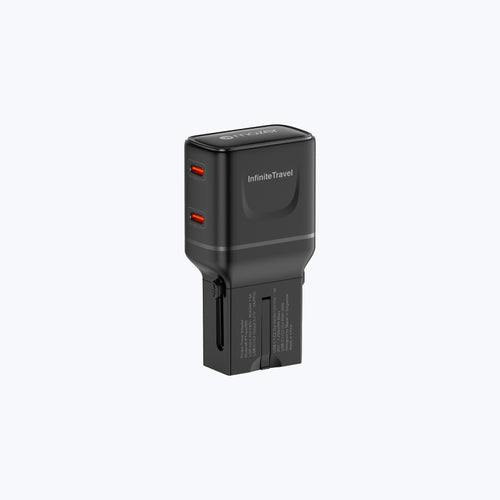
The fix is to stop separating "adapter" from "charger." A universal travel charger does both. The InfiniteTravel Pocket 65W Universal Travel Charger ($59.90 SGD) carries built-in US, UK, EU and Australian pins, so it covers every country in the table above, and it charges through two USB-C ports at up to 65W using GaN7 technology. That 65W is enough to run a laptop, not just top up a phone, and the whole thing is 106 grams and pocket-sized. The pins lock in place with a pin-lock system, so they do not slide loose mid-charge, and it accepts 100 to 240V input, which means it works in Japan, Korea, the UK and everywhere else on the list without a second thought.

InfiniteTravel Pocket 65W Universal Travel Charger.
If you travel with more devices, the InfiniteTravel PD70W GaN Universal Travel Charger ($69.90 SGD) adds a third USB-C port and two USB-A ports on the same universal-pin body, which suits a family sharing one charger at the hotel desk. Either way, the point stands: you carry one object instead of three, and you charge at real speed. GaN chargers run cooler and smaller than the old silicon bricks, which is the reason a 65W unit now fits in a coin pocket. USB Power Delivery is the standard doing the fast-charging work here, explained plainly by the USB-IF.

InfiniteTravel PD70W GaN Universal Travel Charger, for charging several devices from one socket.
What to check before you buy a travel adapter
- Pin coverage: confirm it carries US, UK, EU and Australian pins, which together cover China, Japan, Korea, Thailand and beyond.
- Dual voltage: look for "Input 100 to 240V" so it works in low-voltage Japan and high-voltage Singapore alike.
- Built-in charging: a USB-C PD port means you skip a separate wall charger and charge faster.
- Wattage that matches your kit: 20W tops up phones, 65W or more runs a laptop.
- A locking pin mechanism: loose pins are the most common travel-adapter annoyance, so a pin-lock system is worth having.
The one-bag answer for your next trip
So, which travel adapter do you need? For a China, Japan, Korea, Thailand or wider-Asia trip, one universal travel charger with US, UK, EU and Australian pins and a USB-C PD port replaces the whole drawer of adapters and bricks. For the UK alone, your Singapore plug already fits, so pack a charger and skip the adapter. The InfiniteTravel Pocket 65W handles every destination in this guide, and the rest of the Mazer travel adapters collection covers lighter and higher-power options if your packing list looks different.
TL;DR
For China, Japan, South Korea and Thailand you need a travel adapter because none use Singapore’s Type G plug, while the UK needs no adapter at all. A single universal travel adapter with US, UK, EU and Australian pins covers every country on this list, and one with built-in USB-C charging means you carry a charger and an adapter in a single pocket-sized unit.
Frequently Asked Questions about travel adapters by country
Quick answers to the questions Singapore travellers ask most before a trip.
1. Do I need a travel adapter for Japan?
Yes, you need a travel adapter for Japan. Japan uses flat Type A and B plugs that do not fit Singapore’s Type G sockets, and it runs at 100V, though modern phone and laptop chargers handle that voltage automatically.
2. Do I need a travel adapter for the UK?
No, you do not need a travel adapter for the UK from Singapore. Both use the same three-pin Type G plug, so your existing chargers plug straight into a British socket.
3. What travel adapter do I need for China?
For China you need an adapter that covers Type A, C and I sockets. China’s Type I looks like the Australian plug but is not always identical, so a universal adapter is safer than forcing an Australian plug in.
4. Is one universal travel adapter enough for a multi-country Asia trip?
Yes, a universal travel adapter with US, UK, EU and Australian pins covers China, Japan, Korea, Thailand, Vietnam, Indonesia and most of Asia in a single unit, which is why it beats packing several country-specific adapters.
5. Do I need a travel adapter for Thailand?
Yes, but Thailand is forgiving. Its sockets commonly accept both flat US-style and round European pins, so most universal travel pins fit without trouble.
6. Do I need a travel adapter for Bali?
Yes, Bali uses the same round-pin Type C and F sockets as the rest of Indonesia at 230V, so you need an adapter with European-style round pins.
7. Will my Singapore charger get damaged by different voltages?
No, as long as the charger is labelled "Input 100 to 240V," which nearly every modern phone, laptop and camera charger is. The voltage difference only risks non-dual-voltage appliances like some hair tools.
8. What is the difference between a travel adapter and a travel charger?
A travel adapter only changes the plug shape, while a universal travel charger changes the plug shape and charges your devices through built-in USB ports. A charger like the InfiniteTravel Pocket 65W replaces both, so you carry one item instead of two.
9. How many watts do I need in a travel adapter?
For phones and tablets, 20W is plenty, while 65W or more lets you charge a laptop directly. A 65W GaN charger covers a phone and a laptop at once without getting bulky.
10. Can I bring a travel adapter and power bank on a plane?
Yes. Travel adapters carry no restrictions, and power banks under 100Wh (roughly 27,000mAh) are allowed in carry-on only, never checked. See the IATA lithium battery guidance for the current rules.
Get 15% off your first order
Sorting your charging kit before a trip? Join the Mazer mailing list for 15% off your first order, plus early word on new travel chargers and adapters. It is the easy way to land the travel adapter that fits your route before you fly.
About Mazer
Founded in 2010, Mazer is a Singapore-based brand trusted by over 500,000 customers, with 1.8M+ units sold, offering high-quality, smarter, and eco-friendly technology designed for everyday life #mazer
Shop this guide

More guides like this


Join our community
Get early access to new products, exclusive deals, and free product trials.