
Travel
Universal Travel Adapter Guide for Singapore Travellers
A universal travel adapter changes your plug shape, not your voltage. Here is what Singapore travellers actually need, and how to pick one that also fast-charges.

A universal travel adapter changes the shape of your plug so it fits a foreign socket. That is all it does. It does not change the voltage, and for phones, laptops and tablets you almost never need it to, because those chargers already run on 100 to 240V. So for most Singapore travellers, one good universal travel adapter is the whole answer, and the only real question is whether it also charges your devices fast enough to be worth the space in your bag.
This guide clears up the adapter-versus-converter confusion that trips people up, walks through what actually matters when you buy one, and shows where a charger like the InfiniteTravel range fits in. Mazer has been building charging gear from Singapore since 2010, trusted by over 500,000 customers, and every product is backed by a 24-month warranty. You already have the short answer. Here is the part that saves you money.
The universal travel adapter mistake that costs money
Picture the scene. You land in London, unpack, and reach for the little white cube that came with your Singapore phone. The pins do not fit. Someone at the hotel desk mentions a "converter," you panic-buy a chunky transformer at the airport for far more than it should cost, and you lug it around for a week. You never needed it.
Here is where the confusion starts. Two different products get called the same thing in casual conversation. A plug adapter reshapes the pins so your plug physically fits the wall. A voltage converter changes the electricity itself, stepping 230V down to 110V or the reverse. They are not interchangeable, and buying the wrong one is the single most common travel-power mistake.
For the record, Singapore itself runs on 230V at 50Hz using the three-rectangular-pin Type G plug, the same as the UK. If you are coming home from a 110V country, or heading to one, the plug type and voltage are the two things to check before anything else.
Why you usually need an adapter, not a converter
Look at the small print on your charger. If it reads "Input: 100 to 240V, 50/60Hz," that charger is dual-voltage. It already handles the electricity anywhere in the world on its own. All it needs from you is a plug that fits the wall. That covers nearly every phone charger, laptop brick, tablet plug and camera charger made in the last decade.
A voltage converter only enters the picture for single-voltage appliances, the ones built for 110V only or 230V only with no range printed on them. Think a cheap travel hair dryer, some hair straighteners, an older shaver. Those are the exceptions, they draw a lot of power, and honestly a dual-voltage version of the appliance is usually the safer buy than a converter. For your actual electronics, the converter is dead weight.
So the practical rule is short. Match the plug shape with an adapter. Check that each device says 100 to 240V. If something does not, leave it home or buy the dual-voltage version there.
| Job | Plug adapter | Voltage converter |
|---|---|---|
| Changes the plug shape | Yes | No |
| Changes the voltage | No | Yes |
| Needed in Singapore for a US 2-pin plug | Yes | Only if the device is 110V-only |
| Needed for a phone or laptop charger | Yes (shape only) | No, they are 100 to 240V |
| Needed for a US-only hair dryer | Yes | Yes |
| What a Mazer InfiniteTravel is | This, plus USB-C charging | Not this |
Adapter versus converter, and which job a universal travel adapter actually does.
What actually fixes it: one adapter that also charges
Once you accept that you almost certainly need an adapter and not a converter, the buying decision gets simple, and a little more interesting. The old-school move was a plastic block that only reshaped the pins. You still had to pack the wall charger for every device on top of it. The better move is a universal travel adapter that reshapes the pins and delivers USB-C fast charging, so it replaces your chargers instead of joining them.
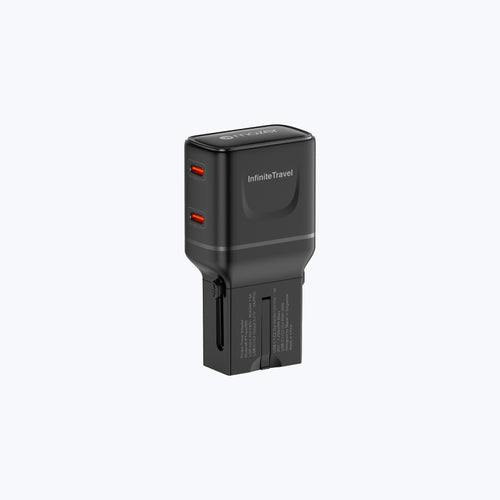
This is where a charger like the InfiniteTravel Pocket 65W Universal Travel Charger earns its place. It carries swappable pins for US, UK, EU and AU sockets, which covers travel across 224+ countries, and it puts out 65W over two USB-C ports using GaN7 technology. That 65W is enough to charge most 13-inch laptops at full speed, or split 45W and 20W across a laptop and a phone at the same time. It weighs 106g and measures 84.5 by 46 by 27mm, so it lands somewhere near a small stack of business cards in your pocket. It is $59.90 SGD.

The InfiniteTravel Pocket 65W: swappable pins plus dual USB-C fast charging in a 106g body.
One honest caveat on the pins. A universal adapter with folding or clip-in pins is only as good as the mechanism that holds them. The InfiniteTravel range uses a pin-lock system so the plugs stay seated in the socket instead of working loose, and an InfiniteShield 3.0 layer with six built-in safety features. If you are the sort of traveller who juggles a phone, earbuds and a laptop, the lighter InfiniteTravel Pocket 45W at $39.90 SGD covers phones and tablets, while the 65W is the one to reach for the moment a laptop is in the bag.
When one hotel outlet is not enough
There is a second scenario the pocket models do not solve. You are back in the hotel room, there is exactly one free socket behind the nightstand, and you have a phone, a watch, earbuds, a tablet and a laptop all begging for power before morning. A single-port adapter turns that into a queue.
For that, the InfiniteTravel PD70W GaN Universal Travel Charger is the desk-anchor version. It has built-in JP/US, CN, TW, UK, AU and EU sockets, ships with EU, US, UK and AUS plug types, runs on 100 to 240V worldwide, and spreads power across multiple USB-C and USB-A ports plus AC input, with 10A surge protection and dual fuses for the safety margin. It is the one adapter that turns a single foreign socket into a small charging station, at $69.90 SGD. Heavier than the Pocket, yes. That is the trade for feeding the whole nightstand at once.

The InfiniteTravel PD70W: four built-in plug types and multi-device output for the one-socket hotel room.
What to check before you buy a universal travel adapter
If you only remember one list from this guide, make it this one.
- Plug coverage: confirm it carries US, UK, EU and AU pins, which covers the vast majority of destinations from Singapore.
- USB-C wattage: aim for 45W if you only carry a phone and tablet, 65W or more the moment a laptop is involved.
- Pin security: a lock or latch keeps the swappable pins from working loose in the socket mid-charge.
- Safety layers: look for surge protection, fusing and a named safety system rather than a bare no-name block.
- Weight and size: a pocket unit near 100g travels easily, a multi-port desk unit is worth the bulk only if you charge many devices at once.
- It is an adapter, not a converter: none of these change voltage, so check each device reads 100 to 240V.
The short version for your next trip
For nearly every Singapore traveller, a universal travel adapter is all you need, and the smartest one also fast-charges so you can leave the wall chargers at home. Pick the pocket 65W if a laptop travels with you, the PD70W if you need to power a whole nightstand from one socket, and skip the converter unless you are packing a single-voltage appliance. Browse the full travel adapters collection to match one to how you travel.
TL;DR
A universal travel adapter changes your plug shape, not your voltage, and since phones and laptops already run on 100 to 240V, a plug adapter is almost always all you need, not a converter. The best pick also fast-charges over USB-C, like the InfiniteTravel Pocket 65W for laptop travel or the PD70W for charging several devices from one socket. Only reach for a voltage converter if you are carrying a single-voltage appliance such as a cheap hair dryer.
Frequently asked questions about universal travel adapters
Quick answers to what Singapore travellers ask most before a trip.
Do I need a travel adapter or a voltage converter?
You almost certainly need a travel adapter, not a converter. An adapter reshapes the plug to fit the socket, while a converter changes the voltage, and modern phones, laptops and tablets already accept 100 to 240V, so they only need the plug reshaped. A converter is only for single-voltage appliances like some hair dryers.
What travel adapter do I need coming from Singapore?
From Singapore you need an adapter that carries US, UK, EU and AU pins, since those cover most destinations, or a universal travel adapter that includes all of them in one unit. Singapore uses the Type G plug, so travelling the other way, into Singapore, visitors from two-pin countries need a Type G adapter.
Does a universal travel adapter change the voltage?
No. A universal travel adapter only changes the plug shape, never the voltage. This is why you still have to check that each device reads 100 to 240V on its label. If a device is single-voltage, an adapter alone will not make it safe to use abroad.
Will my phone and laptop charger work overseas with just an adapter?
Yes, in almost every case. Nearly all phone and laptop chargers are dual-voltage, marked "Input 100 to 240V, 50/60Hz," so a plug adapter is all they need. A charger like the InfiniteTravel Pocket 65W goes further by replacing those chargers with built-in USB-C fast charging.
How many watts should a travel adapter with USB-C have?
For a phone and tablet, 45W is plenty. The moment a laptop joins the trip, aim for 65W or more so it charges at full speed, which is why the InfiniteTravel Pocket 65W splits its output as 45W plus 20W across two USB-C ports.
Is a universal travel adapter safe to use?
It is safe when it has proper protection built in. Look for surge protection, fusing and a named safety system rather than an unbranded block. The InfiniteTravel range uses an InfiniteShield 3.0 layer with six safety features and a pin-lock system so the plugs stay firmly seated during use.
Can one travel adapter charge more than one device?
Yes. The InfiniteTravel Pocket 65W charges two devices at once over dual USB-C, and the InfiniteTravel PD70W spreads power across several USB-C and USB-A ports plus AC input, which is useful when a single hotel socket has to feed a phone, watch, earbuds and a laptop.
How much does a good universal travel adapter cost in Singapore?
A quality universal travel adapter that also fast-charges runs roughly $30 to $70 SGD. In the Mazer range the Pocket 45W is $39.90 SGD, the Pocket 65W is $59.90 SGD, and the multi-port PD70W is $69.90 SGD. Prices are set on the product pages and can change, so check before you buy.
Get 15% off your first order
Planning a trip and sorting out your charging kit? Join the Mazer mailing list for 15% off your first order, plus early word on new travel chargers and launch promotions. It is an easy way to pick up your universal travel adapter for a little less before you fly.
About Mazer
Founded in 2010, Mazer is a Singapore-based brand trusted by over 500,000 customers, with 1.8M+ units sold, offering high-quality, smarter, and eco-friendly technology designed for everyday life #mazer
Shop this guide


More guides like this


Join our community
Get early access to new products, exclusive deals, and free product trials.