


Chargers & Cables
Chargers & Cables
What Is a GaN Charger? Why Singapore Buyers Are Switching in 2026
A GaN charger uses gallium nitride to charge faster, run cooler, and pack smaller than old bricks. Here is why Singapore buyers are switching in 2026, and what to look for.

A GaN charger is a wall charger built with gallium nitride instead of the silicon used in older adapters, and that one material swap is why it charges faster, runs cooler, and fits in a size that used to be impossible. GaN handles power more efficiently, so a single palm-sized unit can push 65W, 100W, even 140W into a laptop, a phone, and a tablet at the same time. That is the whole reason Singapore buyers are switching in 2026: same power, a fraction of the bulk.
This guide explains what a GaN charger actually does differently, why the old brick got hot and slow, and how to pick the right one for a carry-on, a desk, or a small flat. Mazer has been building charging gear from Singapore since 2010, trusted by over 500,000 customers and backed by a 24-month warranty, so the picks here come from real specs, not marketing. Read more: our wall chargers collection.
The brick problem every Singapore desk knows
You know the drawer. The fat white laptop brick, the phone plug, the tablet charger, the travel adapter you bought for a trip to Bangkok. Four separate things, all warm to the touch, all fighting for one power point behind the TV console in a HDB flat. Plug the laptop adapter in for an hour and the top of it is hot enough to notice.
That heat is not a quirk. It is wasted energy. Traditional chargers run on silicon, and silicon leaks a meaningful slice of the power passing through it as heat instead of sending it to your battery. To hit higher wattage, the old design just got bigger and hotter. So for years the trade was simple and annoying: more power meant a heavier brick and a warmer bag.
Why a GaN charger runs cooler and smaller
The fix is the material. GaN, short for gallium nitride, is a wide-bandgap semiconductor. In plain terms, it can handle higher voltages and switch far faster than silicon while losing less energy as heat. The physics behind that is the bandgap: silicon sits around 1.1 electron-volts, while gallium nitride is about 3.4, as materials scientists at AZoM explain. A wider bandgap means the chip tolerates more without breaking down, so engineers can shrink everything around it.
The result you can hold. Mazer’s GaN units run at roughly 95% power efficiency with a cooler exterior, around 60C at the surface under load, and they come in up to 60% smaller than the silicon brick they replace. Less heat, less size, same job. The CSIS has written about why this same efficiency is pushing GaN into everything from phone chargers to electric cars. Your charger just happens to be the first place most people meet it.
What actually fixes the drawer
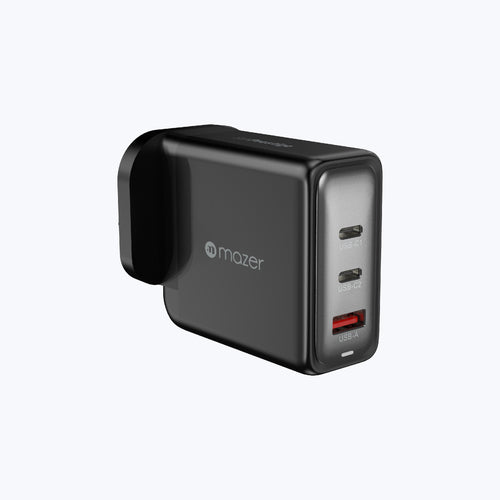
Here is where the switch pays off. Because one GaN charger runs cool at high wattage, it can carry multiple ports and replace that whole drawer. The GaNPrestige 100W GaN Wall Charger is the clearest example: three ports (two USB-C plus one USB-A), up to 100W total, and a body about 60% smaller than an equivalent silicon adapter. That is enough to charge a MacBook at 65W and top up a phone at the same time from one plug. When it is in stock it sits at $79.90 SGD, and both colours can sell out, so check the page for current availability.

GaNPrestige 100W GaN Wall Charger (3 Ports).
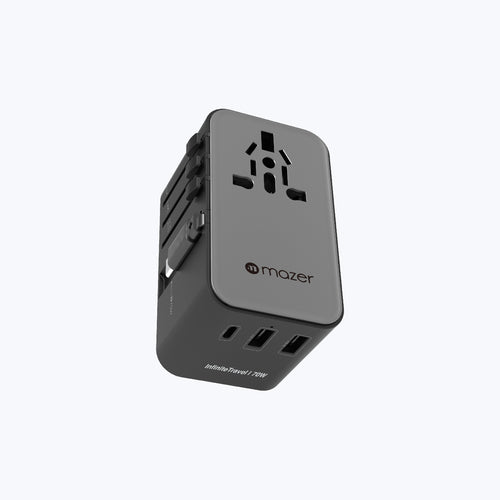
If the switch is really about travel, the logic goes further. The Infinite Travel PD70W GaN Universal Travel Charger folds a GaN charger, a built-in retractable USB-C cable, and JP/US, AU, EU and UK sockets into one block rated for use in over 224 countries, charging up to 4+1 devices at once with InfiniteShield protection against over-current, over-voltage, overheating and short circuits. One thing in the bag instead of a charger, a cable, and a travel adapter. Yes, the very high-wattage GaN units are still a little heavier than a tiny 20W plug, that is the honest trade for running a laptop.

InfiniteTravel PD70W GaN Universal Travel Charger.
GaN charger vs a traditional charger at a glance
If you only remember one thing, remember this table. It is the same power story, told across the things you actually feel day to day.
| What you feel | Traditional silicon charger | GaN charger |
|---|---|---|
| Size and weight | Bulky brick, heavy in the bag | Up to 60% smaller for the same output |
| Heat | Runs warm, sometimes hot | Around 95% efficient, cooler exterior (about 60C) |
| Ports | Often one port, one device | Two to four ports, laptop plus phone at once |
| Travel | One more thing to pack | Built-in or included worldwide pins on travel models |
| Max output (single) | Commonly 20W to 30W | Up to 100W and beyond per unit |
GaN charger vs a traditional silicon charger, on the points buyers notice. Specs reflect Mazer GaNPrestige and Infinite Travel models.
What to look for before you switch
Not every GaN charger is the right GaN charger. A quick checklist that saves regret:
- Total wattage: match it to your heaviest device. 30W to 35W suits a phone, 65W runs most ultrabooks, 100W and up covers a full MacBook Pro plus extras.
- Port mix: more USB-C is better for modern gear, but keep one USB-A if you still carry older cables or accessories.
- Power sharing: check how watts split when every port is full, since a 100W charger rarely gives 100W to one port with three devices attached.
- Travel pins: if you fly, pick a model with built-in or included worldwide pins so you drop the separate adapter.
- Safety and warranty: look for multi-layer protection and a real warranty. Mazer covers its chargers for 24 months.
The switch, in one line
A GaN charger is not a gimmick, it is the old brick done right: cooler, smaller, and able to run your whole desk from one plug. That is why Singapore buyers are switching in 2026, and why the drawer of tangled adapters is finally optional. Start with the wattage your laptop needs, then browse the full chargers collection and pick the port mix that fits your bag.
TL;DR
A GaN charger uses gallium nitride instead of silicon, so it charges fast, runs cooler, and packs up to 60% smaller than a traditional adapter, often with several ports in one unit. Singapore buyers are switching in 2026 because one small GaN charger can replace a drawer of bricks and travel adapters. Match the wattage to your laptop, favour USB-C ports, and check for worldwide pins if you fly.
Frequently Asked Questions about GaN Chargers
Quick answers to the questions Singapore shoppers ask most before buying a GaN charger.
1. What is a GaN charger in simple terms?
A GaN charger is a wall charger built with gallium nitride chips instead of silicon, which lets it charge faster, run cooler, and stay much smaller than an old adapter. The performance you notice comes entirely from that material change inside the plug.
2. Is a GaN charger better than a normal charger?
For most people, yes, a GaN charger is better than a normal silicon charger because it delivers the same or higher wattage in a smaller, cooler body, often with multiple ports. A basic 20W phone plug is still fine if you only ever charge one phone slowly.
3. Are GaN chargers safe to use?
GaN chargers are safe when they include proper protection circuits. Quality models like Mazer’s use multi-layer safeguards against over-current, over-voltage, overheating and short circuits, and the GaN material itself runs cooler than silicon, which reduces heat stress.
4. How many watts do I need in a GaN charger?
Match the wattage to your biggest device: around 30W to 35W for a phone, 65W for most laptops, and 100W or more for a large MacBook Pro plus a second device. Buying a bit above your top device leaves headroom for charging two or three things at once.
5. Can a GaN charger charge a laptop and a phone at the same time?
Yes, a multi-port GaN charger can charge a laptop and a phone together, which is a big reason to switch. Just remember the total wattage is shared, so a 100W unit might send 65W to the laptop and 30W to the phone rather than 100W to each.
6. Will a GaN charger work overseas?
Most GaN chargers accept universal 100 to 240V input, so the electronics work worldwide. For plug shape, choose a travel model like the Infinite Travel PD70W with built-in or included JP/US, AU, EU and UK pins so you do not need a separate adapter.
7. How much does a good GaN charger cost in Singapore?
A good GaN charger in Singapore ranges from around $20 to $30 SGD for a compact 20W to 35W plug up to roughly $80 to $190 SGD for high-wattage multi-port and travel units. Check the Mazer product page for the current price, since colours and stock change.
8. Why do GaN chargers stay cooler than old ones?
GaN chargers stay cooler because gallium nitride wastes less energy as heat than silicon, running at roughly 95% efficiency. Less wasted heat means a lower surface temperature and a smaller housing, since the design does not need as much bulk to shed warmth.
Get 15% off your first order
If you are ready to retire the brick drawer, join the Mazer mailing list for 15% off your first order plus early word on new chargers and travel gear. It is the easiest way to make your first GaN charger a little cheaper.
About Mazer
Founded in 2010, Mazer is a Singapore-based brand trusted by over 500,000 customers, with 1.8M+ units sold, offering high-quality, smarter, and eco-friendly technology designed for everyday life #mazer
Shop this guide
More guides like this

Chargers & Cables
Best Chargers for iPad and Tablets in Singapore

Chargers & Cables
Best Chargers for MacBook Air and MacBook Pro in Singapore
Join our community
Get early access to new products, exclusive deals, and free product trials.